1

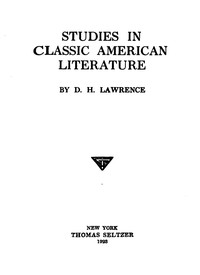
Studies in Classic American Literature — Reading Companion
(0 User reviews)
1212
Project Gutenberg
2019
Not confirmed
American literature -- History and criticism
Readers of public-domain and historical texts
Project Gutenberg digital edition
en
Edition facts
Words
63,485
Reading time
277 min
Text sections
6
Studies in Classic American Literature — Reading Companion can be approached with a clearer sense of reading commitment from its source measurements: 63,485 words, 4 hr 37 min estimated reading time, and 6 detected text sections.
The text analysis averages about 13.0 words per sentence, while the detected sections provide another way to judge how the source is divided.
Project Gutenberg metadata also associates the work with “American literature -- History and criticism,” connecting these edition facts with the source record’s subject description.
Source:
Project Gutenberg record #60547
D. H. Lawrence's provocative 1923 study of American literature, examining Franklin, Cooper, Poe, Hawthorne, Melville, and Whitman through a lens of national identity and psychological conflict, with a distinctive, combative prose style.
Editorial Edition Score
4.7/5
★★★★★
★★★★★
Calculated from edition completeness, EPUB availability, text structure and catalogue metadata. Not a user rating.
How this score is calculated
- Description quality20 pts
- Title & short description10 pts
- Source metadata20 pts
- Text length15 pts
- Chapters / structure15 pts
- EPUB file integrity20 pts
Total of 100 points, scaled to a 2.5-5.0 range. Editions with an empty description or a missing EPUB file are not scored.
Edition quality
Public-domain source text
Read the source text
The source text is kept in the dedicated reader, separate from this catalogue record and its commentary.
D. H. Lawrence opens Studies in Classic American Literature with a direct challenge to American readers: "Listen to the States asserting: 'The hour has struck! Americans shall be American.'" He immediately undercuts this declaration by asking where the "true American" is hidden, calling him a "missing link of the next era." This combative, interrogative tone—part mockery, part earnest search—sets the stage for a book that is less a conventional critical survey than a series of passionate, often abrasive engagements with a handful of American writers. Lawrence treats literature as a symptom of deeper cultural and psychological forces, and his own voice is as much a subject as the authors he discusses.
A Voice That Refuses to Be Academic
Lawrence’s prose in this book is deliberately anti-academic. He uses rhetorical questions, exclamations, and colloquial asides: "All right, Americans, let's see you set about it. Go on then, let the precious cat out of the bag." He invents a mock-Latin catechism—"Ubi est ille Toad-in-the-Hole?"—to parody the search for an authentic American identity. The writing is performative, as if Lawrence is speaking directly to the reader, sometimes hectoring, sometimes cajoling. He does not build arguments step by step; instead, he makes abrupt, aphoristic claims: "The furthest frenzies of French modernism or futurism have not yet reached the pitch of extreme consciousness that Poe, Melville, Hawthorne, Whitman reached." This style can feel exhilarating or exhausting, but it never sounds like a lecture.
The American Writer as a Creature on the Verge
Lawrence repeatedly describes American literature as having "come to a real verge" or "reached a limit." He contrasts the "old people"—Hawthorne, Poe, Dana, Melville, Whitman—with European modernists, arguing that the Americans were already at an extreme of consciousness without trying. This framing is not historical or biographical; it is a claim about the psychological intensity of the work. Lawrence treats each author as a case study in a kind of spiritual crisis. In his discussion of The Scarlet Letter, he calls Hester Prynne "a devil" and writes of her "revenge" against man, using the language of demonology and sexual conflict. He does not argue for this interpretation so much as assert it, building his case through repetition and rhetorical force.
Recurring Preoccupations: Women, Belief, and the Body
Throughout the excerpts, Lawrence returns to a set of linked ideas: the failure of male belief, the consequent devilishness of women, and the need for a renewed "submissiveness to the dark, phallic principle." He writes that "if a woman doesn't believe in a man, she believes, essentially, in nothing. She becomes, willy-nilly, a devil." This is not a detached critical observation; it is a provocation. Lawrence reads Hester Prynne as a type of the modern woman, and he predicts a future of polygamy and "half-oriental womanhood." These passages reveal Lawrence’s own system of thought—his investment in a kind of primal, pre-conscious vitality—as much as they illuminate Hawthorne’s novel. The reader must decide how much of this is insight and how much is projection.
Lawrence’s Studies rewards readers who enjoy a critic who is willing to be wrong, outrageous, and unforgettable. The book is best approached not as a source of settled judgments but as a performance—a series of encounters in which Lawrence’s own obsessions are laid bare. Readers may find themselves arguing with him on every page, but that is precisely the point. The book demands a response, not passive acceptance.
Rereading Studies in Classic American Literature, I keep returning to Lawrence’s fury at how Americans invent themselves—the self as a performance, a survival trick. It made me think of that old serial, The movie boys in peril — Context and Discussion, where boys act their way through dangers. Strange, how the same anxious posing shows up in penny dreadfuls and high-minded essays alike.
There are no reviews for this eBook.
There are no comments for this eBook.
Reader reflection
Before you leave, reflect on the book
Use these questions to collect your thoughts before moving on.
Your progress
0
/
10
2
How did the book work for you overall?
3
Is this a title you would suggest to others?
4
What was the reading difficulty like?
5
How clear did the writing feel?
6
How original did the book feel?
7
Which element worked best for you?
8
How strongly did the book affect you emotionally?
9
What is the main idea you are taking away?
10