1

A Horse's Tale — Inside the Classic
(0 User reviews)
85
Project Gutenberg
1997
Not confirmed
Fiction
Readers of public-domain and historical texts
Project Gutenberg digital edition
en
Edition facts
Words
21,331
Reading time
93 min
Text sections
18
For A Horse's Tale — Inside the Classic, the stored edition analysis reports 21,331 words, 1 hr 33 min estimated reading time, and 18 detected text sections.
The text analysis averages about 19.6 words per sentence, while the detected sections provide another way to judge how the source is divided.
Project Gutenberg metadata also associates the work with “Fiction,” connecting these edition facts with the source record’s subject description.
Source:
Project Gutenberg record #1086
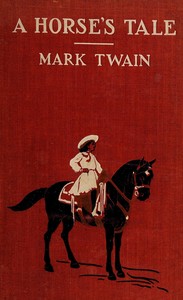
Mark Twain's 1907 novella narrated by Buffalo Bill's horse, Soldier Boy, blending animal perspective with military life and a talking-dog subplot, marked by playful neologisms and a self-aware preface.
Editorial Edition Score
4.8/5
★★★★★
★★★★★
Calculated from edition completeness, EPUB availability, text structure and catalogue metadata. Not a user rating.
How this score is calculated
- Description quality20 pts
- Title & short description10 pts
- Source metadata20 pts
- Text length15 pts
- Chapters / structure15 pts
- EPUB file integrity20 pts
Total of 100 points, scaled to a 2.5-5.0 range. Editions with an empty description or a missing EPUB file are not scored.
Edition quality
Public-domain source text
Read the source text
The source text is kept in the dedicated reader, separate from this catalogue record and its commentary.
Mark Twain opens A Horse's Tale with a preface that frankly discloses his borrowings: a bullfight scene from John Hay's Castilian Days, military minutiae from Army Regulations and Hardy's Tactics, and a bugle-call lifted from Delibes's Sylvia. He also admits to scattering “anachronisms and unborn historical incidents” to help the tale “over the difficult places,” citing Herodotus as precedent. This candor sets a playful, self-conscious tone that carries into the narrative proper, where the first chapter is titled “Soldier Boy—Privately to Himself” and the horse speaks in the first person, describing his rider Buffalo Bill as “good for two hundred pounds, without his clothes.”
A Horse's Private Voice
The decision to let Soldier Boy narrate his own story is the book's most striking authorial choice. Twain gives the horse a distinct, colloquial idiom: he refers to himself as “Buffalo Bill's horse,” notes that Bill “is good for two hundred pounds, without his clothes,” and describes the bugle call as saying “It is I, Soldier—come!” The voice is direct, observant, and slightly sardonic, but never sentimental. Soldier Boy's perspective is limited to what a horse might plausibly notice—sounds, smells, the weight of a rider—yet Twain expands that range by having the horse understand human speech and even comment on grammar. The result is a narrative filter that is both naive and knowing, allowing Twain to satirize human pretensions without abandoning the logic of an equine viewpoint.
Playful Lexicon and Taxonomic Jokes
In the dialogue between Soldier Boy and the dog Shekels, Twain invents a mock-scientific classification for reptiles: “a plantigrade circumflex vertebrate bacterium that hasn't any wings and is uncertain.” The dog repeats this phrase with reverence, and the horse accepts it as a compliment, noting that “often a duke is called a reptile; it is set down so, in history.” This exchange does double duty: it parodies the jargon of natural history while also satirizing social hierarchy. The humor depends on the animals' earnest acceptance of nonsense as elevated truth. Twain's willingness to let the joke run—Shekels asks for the definition twice, slowly—shows his confidence in the comic potential of misapplied erudition.
Structure as a Patchwork of Forms
The book's table of contents reveals a deliberately mixed structure: chapters alternate between first-person horse monologues, letters among human characters, and third-person scenes. Chapter II is “Letter from Rouen—To General Alison,” Chapter III is “General Alison to his Mother,” and later chapters return to Soldier Boy's private thoughts. This variety prevents any single voice from dominating and allows Twain to shift register from the horse's earthy observations to the formalities of military correspondence. The preface's confession of borrowed material reinforces the sense that the book is a constructed artifact, not a seamless narrative. Readers should expect abrupt transitions and a willingness to break the fourth wall.
Threats and Undercurrents in a Comic Frame
Beneath the whimsy, the excerpts hint at genuine danger. Shekels reports that outlaws are plotting to kill Buffalo Bill, and Soldier Boy responds, “Shekels, I don't like the look of it.” The threat is treated matter-of-factly, without melodrama, but it introduces a note of mortality into the otherwise light proceedings. Twain's preface also mentions that he needed a bullfight “in this book,” and the illustrations list includes a scene where “His strength failed and he fell at her feet.” The comic animal voices and the self-deprecating preface may serve as a counterweight to darker episodes. The reader should be alert to shifts in tone, as the book does not promise a uniformly cheerful outcome.
Twain's preface invites the reader to view A Horse's Tale as a deliberate patchwork—borrowed scenes, anachronisms, and all. The animal narrators are not sentimentalized; they speak with a dry, knowing wit that undercuts any easy moral. Pay attention to the moments when the comedy falters or the threats become real, for those are where the author's hand is most visible. The book rewards a reader who enjoys formal play and is willing to let a horse have the last word.
There’s something about Twain’s Soldier Boy that stays with you—that quiet dignity in a world that doesn’t quite understand him. I found a similar ache in Falk: A Reminiscence — Inside the Classic, where the narrator’s memory drifts like a horse grazing after a long ride. Both feel like letters from a younger self, slightly bemused, slightly bruised, and impossibly fond.
There are no reviews for this eBook.
There are no comments for this eBook.
Reader reflection
What was your reading experience?
Capture what you thought, learned, and would like to remember.
Your progress
0
/
10
2
How much did you enjoy the reading experience?
3
Would you encourage someone else to read it?
4
How demanding did the text feel?
5
Would this book work well in a reading group?
6
Would you read this book again?
7
Did any part of the book stay with you emotionally?
8
What did you appreciate most?
9
In one sentence, what did you learn?
10