
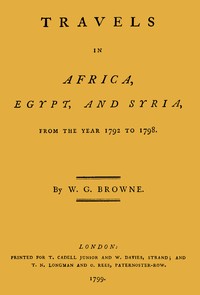
Travels in Africa, Egypt, and Syria, from the year 1792 to 1798 by Browne
Let's set the scene: it's 1792. A young Englishman named William George Browne, with some money and a lot of curiosity, decides to travel to Africa. His goal is vague—to reach the fabled city of Darfur. With no official backing and minimal preparation, he heads off into the unknown. What follows is a six-year journey of incredible hardship.
The Story
This isn't a novel with a neat plot. It's Browne's own account, written as he went. He travels from Egypt south into the deserts of what is now Sudan. Early on, his entire caravan is attacked and he's stripped of almost everything he owns. Broke and alone, he has to rely on the kindness (and sometimes suspicion) of local rulers and merchants just to keep moving. He describes the landscapes in stark detail—the brutal heat, the endless sand, the sudden beauty of an oasis. He writes about the people he meets, from Coptic monks to nomadic tribes, often with the awkward, observational style of someone who doesn't fully understand the world he's in. The 'story' is simply his struggle to exist and observe in a place where he is a perpetual outsider.
Why You Should Read It
You read this for the realness. There's no heroic gloss. When Browne is scared, tired, or frustrated, you know it. His descriptions are not always flattering, either to the places he visits or to himself, which makes them feel honest. It's a window into a world on the cusp of change, seen through the eyes of a very ordinary (if stubborn) man. The value isn't in grand historical analysis, but in the small, human moments: bargaining for a camel, trying to treat an illness with limited supplies, or sitting silently in a market, just watching life go by. It strips away the romance of exploration and shows you the gritty, often tedious, and dangerous reality of it.
Final Verdict
Perfect for readers who love raw, primary-source history and armchair adventurers who want the authentic, unvarnished experience. If you enjoy polished, modern travel writing with a clear narrative arc, this might feel meandering. But if you like the idea of peering over the shoulder of a traveler from 230 years ago, reading his unedited thoughts as he faces genuine peril, it's completely absorbing. It's a challenging but rewarding trip back in time.
No rights are reserved for this publication. Knowledge should be free and accessible.
Susan Wilson
2 years agoAfter spending a few days with this digital edition, the practical checklists included are a great touch for real-world use. This adds significant depth to my understanding of the field.
Kevin Anderson
1 year agoI had low expectations initially, however it challenges the reader's perspective in an intellectual way. Don't hesitate to start reading.
Robert Wilson
1 year agoThis is one of those stories where it creates a vivid world that you simply do not want to leave. A true masterpiece.



Margaret White
6 months agoThe citations provided are a goldmine for further academic study.