
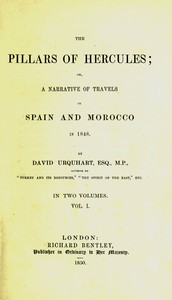
The pillars of Hercules : or, A narrative of travels in Spain and Morocco in…
Okay, let's break this down. 'The Pillars of Hercules' is David Urquhart's personal travelogue from a journey he took in the 1830s. The title refers to the Strait of Gibraltar, the ancient gateway between the Mediterranean and the Atlantic, which also symbolizes his passage from Christian Europe (Spain) into the Muslim world (Morocco).
The Story
The book doesn't have a plot in the novel sense. Instead, it's a series of observations and adventures. Urquhart travels from the south of Spain across the strait into northern Morocco. He describes the landscapes in vivid detail—rugged mountains, arid plains, and crowded cities. He meets local leaders, negotiates with guides, gets caught in bad weather, and observes daily life. A big part of the narrative is his attempt to understand Moroccan politics and society at a time when European powers were very interested in the region. He's constantly analyzing, sometimes praising what he sees, and other times criticizing European interference.
Why You Should Read It
You should read this for the voice. Urquhart is not a neutral observer. He's passionate, biased, curious, and often funny in his exasperation. You get a real sense of the man—his stubbornness, his intelligence, and his deep desire to bridge a cultural divide he sees widening. The book is less about grand historical events and more about the texture of travel: the taste of unfamiliar food, the strain of a long ride, the challenge of a conversation without a common language. It makes history feel immediate and human. It also offers a fascinating, if imperfect, snapshot of a relationship between two worlds that is still relevant today.
Final Verdict
This book is perfect for readers who love classic travel writing with attitude, like the works of Robert Byron or Patrick Leigh Fermor. It's for anyone interested in 19th-century history, diplomacy, or North African culture. A word of caution: it's a product of its time, so some of Urquhart's views will feel dated or problematic to a modern reader. But if you can read it with that context, it's a rewarding and absorbing adventure. Think of it as a long, detailed letter from a very interesting, opinionated friend who went on a trip two centuries ago.
This historical work is free of copyright protections. It is now common property for all to enjoy.
Deborah Clark
1 year agoI started reading out of curiosity and the content flows smoothly from one chapter to the next. Highly recommended.
Michael Nguyen
1 year agoSimply put, the storytelling feels authentic and emotionally grounded. I couldn't put it down.



Linda Williams
8 months agoI started reading this with a critical mind, the case studies and practical examples provided add immense value. This adds significant depth to my understanding of the field.