
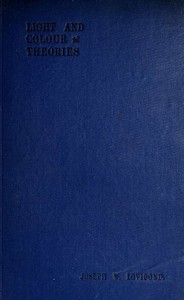
Light and Colour Theories, and their relation to light and colour…
Let's set the scene: It's the late 1800s. Joseph Lovibond is running a brewery. His biggest headache? Making sure every batch of beer has the exact same, perfect color. Back then, there was no scientific way to do this. You just had to eyeball it and hope your judgment matched everyone else's. This drove Lovibond nuts. He was convinced there had to be a better, more precise method.
The Story
This book is Lovibond's report from the front lines of his personal quest. He didn't just complain; he invented something called the 'Tintometer.' Imagine a clever little device that lets you match a color by sliding pieces of colored glass until the view through an eyepiece matches your sample. He then wrote this book to explain the theories of light and color that made his invention work. He breaks down complex ideas about how light splits into colors, how our eyes perceive them, and why his system of red, yellow, and blue glass standards could finally give color a numerical value. The 'plot' is his argument, page by page, building a case for taking color out of the realm of guesswork and into the realm of science.
Why You Should Read It
Here's the cool part: you get to watch a brilliant, practical mind at work. Lovibond wasn't a stuffy academic in an ivory tower. He was a problem-solver. Reading his explanations, you feel his frustration with the vague 'it looks about right' methods of his time and his triumph in creating a real solution. It makes you look at the world differently. You start noticing color everywhere—in a sunset, a painting, the label on a soda bottle—and appreciate that there's a whole hidden science behind what we often take for granted. It connects dots between art, industry, and physics in a way that feels personal, because it started with one man's desire to make better beer.
Final Verdict
This isn't a breezy beach read, but it's incredibly rewarding. It's perfect for curious minds who love stories of forgotten inventors, for science fans who enjoy seeing how big ideas grow from everyday problems, or for anyone in creative fields who wants to understand the foundation of color theory. If you've ever enjoyed a book like 'The Phantom Tollbooth' or wondered about the history of the Pantone system, you'll find a kindred spirit in Joseph Lovibond. Just be prepared to see every shade around you in a new light.
This is a copyright-free edition. Feel free to use it for personal or commercial purposes.
Anthony Wilson
1 year agoWithout a doubt, the plot twists are genuinely surprising. One of the best books I've read this year.



Emily Gonzalez
6 months agoI decided to give this a try based on a colleague's recommendation, the wealth of information provided exceeds the average market standard. A perfect balance of theory and practical advice.