
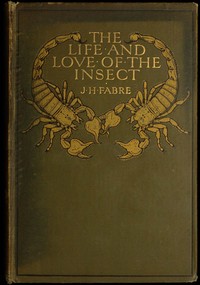
The Life and Love of the Insect by Jean-Henri Fabre
Forget everything you think you know about bug books. The Life and Love of the Insect isn't a field guide or a list of facts. It's a series of vivid, personal stories from a man who was part detective, part poet, and completely obsessed. Jean-Henri Fabre built a little wildlife sanctuary in his own backyard—he called it his 'open-air laboratory'—and just watched. For years.
The Story
There isn't one single plot. Instead, each chapter focuses on a different insect neighbor and the puzzle they present. Fabre follows the hunting wasp, the Ammophila, as she expertly stuns a caterpillar, dragging it home to her burrow as live food for her larva. He meticulously documents the sacred scarab beetle's stubborn, comical struggle to roll its prized dung ball up a hill, only to have it tumble down. He watches caterpillars spin silk, bees build geometrically perfect homes, and ants wage war. The 'story' is the unfolding drama of their daily lives, observed with a patience and wonder that feels almost magical.
Why You Should Read It
You should read it because Fabre makes you care. He gives these creatures personality and stakes. You'll find yourself rooting for the beetle to finally get its ball over the ridge, or feeling a strange mix of horror and respect for the wasp's chillingly efficient hunting method. His writing removes the barrier between 'us' and 'them.' He argues with the scientific ideas of his time, not in a stuffy way, but like a friend saying, 'Hold on, come look at this and tell me what you think.' He asks the big questions about instinct, intelligence, and the purpose behind these complex behaviors, but he never forces an answer down your throat. He just shows you the evidence.
Final Verdict
This book is perfect for anyone with a spark of curiosity about the natural world, whether you're a gardener, a hiker, or just someone who occasionally watches a bee on a flower. It's for readers who love beautiful, clear prose and real-life mysteries. If you enjoyed the quiet observation of Braiding Sweetgrass or the accessible science of writers like Mary Roach, you'll find a kindred spirit in Fabre. Just be warned: after reading it, you might never walk across a lawn the same way again.
This is a copyright-free edition. Enjoy reading and sharing without restrictions.
Paul Jones
8 months agoMy first impression was quite positive because the footnotes provide extra depth for those who want to dig deeper. I'll be recommending this to my students and colleagues alike.
Sarah Martinez
5 months agoSolid information without the usual fluff.
Thomas Johnson
4 weeks agoAs a long-time follower of this subject matter, the attention to detail regarding the core terminology is flawless. I'm genuinely impressed by the quality of this digital edition.
Donald Lee
1 year agoVery satisfied with the depth of this material.



Susan Lee
2 months agoWhile browsing through various academic sources, it addresses the common misconceptions in a very professional manner. A trustworthy resource that I'll keep in my digital library.