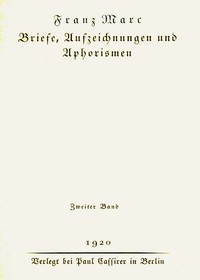
Briefe, Aufzeichnungen und Aphorismen. Zweiter Band by Franz Marc
This isn't a book with a traditional plot. Briefe, Aufzeichnungen und Aphorismen. Zweiter Band (Letters, Notes, and Aphorisms. Volume Two) collects the personal writings of Franz Marc from 1914 until his death in 1916. Think of it as a mosaic of a mind at a critical point.
The Story
The "story" is the journey of Marc's thoughts. We start with his passionate writings about art. He talks about color having a soul—blue as masculine and spiritual, yellow as feminine and gentle. He argues with friends, plans exhibitions for the artist group Der Blaue Reiter, and dreams of a future where art transforms society. Then, World War I begins. The tone shifts. The letters start coming from army training camps and, finally, the front lines in France. You see his initial, almost romantic, patriotism harden into a grim reality. The last writings are brief field postcards and poignant notes where his artistic philosophy collides with the machinery of war. The book ends abruptly, a silent space where his voice was lost.
Why You Should Read It
Reading this is like getting a backstage pass to genius. You see the engine behind the paintings. His idea that animals see a purer world isn't just a cute theme; it's a deeply held spiritual belief he argues for in these pages. What got me was the human contrast. Here's a man who spent his life thinking about harmony and color, suddenly sketching troop movements in the mud. His final aphorisms are hauntingly beautiful and sad, focused on sacrifice and a hope for renewal beyond the catastrophe. It makes his famous works, like Fate of the Animals, feel like prophecies.
Final Verdict
This is a must for anyone who loves art history, but in a very human way. It's perfect for people who enjoy primary sources, diaries, or getting inside an artist's head. If you're fascinated by the early 20th century and how creative people processed the shock of the Great War, you'll find this gripping. Fair warning: it's not a light read. It's fragmentary, philosophical, and often heavy. But if you give it time, it offers a connection to an artistic spirit that feels both timeless and tragically of its moment.
This text is dedicated to the public domain. Use this text in your own projects freely.