1

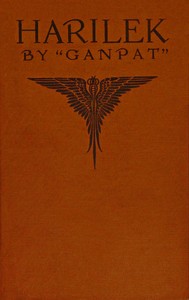
Harilek — Inside the Classic
(0 User reviews)
77
Project Gutenberg
2023
Not confirmed
Science fiction; Fantasy fiction; Love stories; Adventure stories; Asia, Central -- Fiction
Readers of public-domain and historical texts
Project Gutenberg digital edition
en
Edition facts
Words
123,369
Reading time
537 min
Text sections
32
This digital edition of Harilek — Inside the Classic is described by source-level measurements including 123,369 words, 8 hr 57 min estimated reading time, and 32 detected text sections.
The text analysis averages about 19.2 words per sentence, while the detected sections provide another way to judge how the source is divided.
Project Gutenberg metadata also associates the work with “Science fiction,” connecting these edition facts with the source record’s subject description.
Source:
Project Gutenberg record #70913
An editorial note on the structure, recurring images, and movement between scenes in Martin Louis Alan Gompertz's Harilek, a Central Asian adventure romance framed as an edited diary.
Editorial Edition Score
4.9/5
★★★★★
★★★★★
Calculated from edition completeness, EPUB availability, text structure and catalogue metadata. Not a user rating.
How this score is calculated
- Description quality20 pts
- Title & short description10 pts
- Source metadata20 pts
- Text length15 pts
- Chapters / structure15 pts
- EPUB file integrity20 pts
Total of 100 points, scaled to a 2.5-5.0 range. Editions with an empty description or a missing EPUB file are not scored.
Edition quality
Public-domain source text
Read the source text
The source text is kept in the dedicated reader, separate from this catalogue record and its commentary.
Harilek opens with a framing device that immediately establishes distance between the reader and the tale: a foreword signed “Ganpat” claims the manuscript was sent by Harry Lake, a soldier met on the Indian frontier. The story is presented as a record of actual adventure, though the editor confesses uncertainty whether it is fact or fantasy. This ambiguity colours every subsequent scene, as the narrative shifts between precise military detail—knife-edged hills, Mahsud snipers, magazine-rifles—and the trappings of a fairy-tale romance: a princess with red-gold hair, wizards, and a hand-locked duel. The journey from Waziristan to the hidden valley of Aornos is marked by constant movement, both geographical and tonal.
The Frame and the Journey
The foreword establishes Harry Lake as a reliable witness—a soldier who served in France and East Africa—yet the editor’s hesitation about the manuscript’s truthfulness invites the reader to treat the narrative as a layered construct. The journey itself is structured as a series of departures and arrivals: from Sorarogha to a London hospital, back to India, then into the unknown. Each transition is marked by practical details—pack-animals, saddles, rifles—that ground the fantastic elements. The movement between scenes is rarely leisurely; characters are often “to horse” within paragraphs, and the landscape shifts from desert to pine forest to cliff-girt stronghold without pause. This relentless forward motion mirrors the protagonist’s own uncertainty about what lies ahead.
Recurring Images of Armour and Weaponry
Weapons and armour appear with notable frequency, often as objects of curiosity or status. The steel cap recovered from a slain Shaman is described as “of curious workmanship, and more ornate than the usual type,” suggesting a hierarchy among the enemy. Forsyth’s rifle is displayed proudly by a soldier, “very proud of the trust reposed in him.” The juxtaposition of modern firearms with six-foot bows and shirts of mail is not merely decorative; it underscores the cultural collision at the heart of the story. Even in dialogue, weapons carry weight: Kyrlos’s decision to bring Payindah because “he was with you in the gate” implies that shared combat creates a bond stronger than rank. These details are never explained at length, but their repetition builds a world where steel and gunpowder coexist uneasily.
Movement Between Camps and Perspectives
The narrative moves fluidly between the protagonist’s first-person observations and the broader political manoeuvring of the Shamans and the people of Aornos. A single ride can shift from casual conversation about clothing to a whispered plot about a feigned death. When Kyrlos receives news of an envoy, the response is immediate: “I would ride there and speak with the man.” The party splits, with some continuing to Aornos while others divert to the fort. This constant regrouping keeps the reader aware of multiple factions and agendas. Even within a single scene, the focus can jump from the shabbiness of travel-worn kit to the ornate steel cap, then to the envoy’s letter. The effect is a world in which no detail is static, and every object or person may carry hidden significance.
The Role of the Diary as Structural Anchor
The story is explicitly presented as a diary, and this format shapes its rhythm. Scenes are episodic, often beginning with a time marker (“Half an hour later saw us in sight of the fort”) and ending with a departure or a pause. The diary frame also allows for digressions—reflections on clothing, observations about horses—that might seem trivial in a conventional novel but here serve to authenticate the narrator’s voice. The editor’s note that the manuscript was “made up from my diary” explains the occasional gaps in continuity; the reader is left to infer what happened between entries. This structure reinforces the sense of a real journey, with all its mundane interruptions and sudden crises, while leaving room for the romance and adventure promised in the opening poem.
Readers approaching Harilek should attend to the way Gompertz uses movement—both physical and narrative—to create tension. The constant travel between locations, the shifting alliances, and the recurring focus on weapons and armour all contribute to a story that feels both grounded in military experience and open to the fantastic. The diary format invites the reader to share the narrator’s uncertainty, making every new scene a discovery.
Sitting with Harilek, I kept noticing how its diary entries drift from one oasis town to the next, never quite settling, like a traveler’s restless sleep. That same wandering warmth surfaced in the editorial notes about Stevenson’s South Sea tales—both books feel less like plotted adventures and more like someone sorting through half-remembered evenings. It made me quietly grateful for editions that preserve that intimate, unfinished quality. Island Nights' Entertainments — Edition Insights reminded me of that sensation.
There are no reviews for this eBook.
There are no comments for this eBook.
Reader reflection
Record your reading impressions
A brief reflection can help important ideas stay with you longer.
Your progress
0
/
10
2
Did this book hold your interest?
3
Is this a title you would suggest to others?
4
How demanding did the text feel?
5
Could you apply anything you learned?
6
Did the story or argument move comfortably?
7
Did you relate to its people, ideas, or situations?
8
Was the book easy to understand?
9
In one sentence, what did you learn?
10