
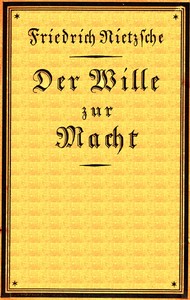
Der Wille zur Macht: Eine Auslegung alles Geschehens by Friedrich Wilhelm Nietzsche
Let's be clear from the start: this is not a novel. There's no story in the traditional sense. 'The Will to Power' is a collection of notes and fragments Nietzsche never finished. It was compiled by his sister after his mental collapse, which adds a complicated layer to the whole thing. Think of it as walking into a brilliant, chaotic workshop. You see half-built ideas, sketches for world-changing thoughts, and sentences that hit you like a lightning bolt. The 'plot' is the unfolding of Nietzsche's central, explosive idea: that beneath all human action, science, art, and morality, there is one fundamental force—the will to power, a drive to grow, overcome, and express life itself.
Why You Should Read It
You should read this not to agree with it, but to wrestle with it. Nietzsche isn't giving you answers; he's taking a sledgehammer to the questions you didn't even know you had. His critiques of pity, democracy, and traditional 'good vs. evil' are brutal and uncomfortable. But within that, there's an incredible call to create your own values, to embrace life with all its pain and beauty, and to become stronger. Reading these fragments, you feel the intensity of a mind working at its absolute limit. It's philosophy as an extreme sport.
Final Verdict
This book is not for everyone. It's dense, fragmented, and can be misinterpreted (a warning Nietzsche himself would shout). But if you're a curious reader tired of easy answers, if you love books that act as a mirror, or if you just want to experience one of the most influential and provocative thinkers in history at his most unfiltered, give it a try. Pair it with a good critical guide or biography to understand the context. Perfect for deep thinkers, philosophy-curious readers, and anyone who believes a book should be a challenge, not just a comfort.
This title is part of the public domain archive. Knowledge should be free and accessible.
Kimberly Brown
3 months agoMy first impression was quite positive because the way it handles controversial points with balance is quite professional. A trustworthy resource that I'll keep in my digital library.
Susan Jackson
3 months agoIt’s refreshing to see such a high standard of digital publishing.
Thomas Thomas
3 months agoExceptional clarity on a very complex subject.
Donald Miller
2 years agoIf you're tired of surface-level information, the structural organization allows for quick referencing of key points. The insights gained here are worth every minute of reading.






Mary Lee
2 years agoGreat value and very well written.