1

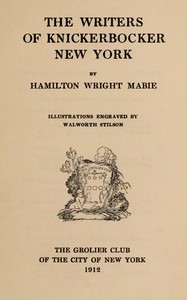
Writers of Knickerbocker New York — Inside the Classic
(0 User reviews)
83
Project Gutenberg
2023
Not confirmed
Authors, American -- 19th century -- Biography; American literature -- New York (State) -- New York -- History and criticism; Authors, American -- Homes and haunts -- New York (State) -- New York; New York (N.Y.) -- Intellectual life; Irving, Washington, 1783-1859 -- Influence; American literature -- 1783-1850 -- History and criticism; City and town life in literature; United States -- Intellectual life -- 1783-1865; New York (N.Y.) -- In literature
Readers of public-domain and historical texts
Project Gutenberg digital edition
en
Edition facts
Words
18,805
Reading time
82 min
Text sections
7
Before opening Writers of Knickerbocker New York — Inside the Classic, the edition data offers a quick orientation: 18,805 words, 1 hr 22 min estimated reading time, and 7 detected text sections.
The text analysis averages about 30.0 words per sentence, while the detected sections provide another way to judge how the source is divided.
Project Gutenberg metadata also associates the work with “Authors, American -- 19th century -- Biography,” connecting these edition facts with the source record’s subject description.
Source:
Project Gutenberg record #71682
Mabie's 1912 portrait of early 19th-century New York's literary circle, focusing on Irving, Drake, and Halleck, with precise observations on social geography, youthful camaraderie, and the tension between urban growth and memory.
Editorial Edition Score
4.6/5
★★★★★
★★★★★
Calculated from edition completeness, EPUB availability, text structure and catalogue metadata. Not a user rating.
How this score is calculated
- Description quality20 pts
- Title & short description10 pts
- Source metadata20 pts
- Text length15 pts
- Chapters / structure15 pts
- EPUB file integrity20 pts
Total of 100 points, scaled to a 2.5-5.0 range. Editions with an empty description or a missing EPUB file are not scored.
Edition quality
Public-domain source text
Read the source text
The source text is kept in the dedicated reader, separate from this catalogue record and its commentary.
Mabie opens by contrasting New York's rapid, destructive growth with Rome's layered rebuilding, calling the modern city a product of 'successive stages of self-effacement.' This framing sets up a study not of a place but of a vanished social and literary milieu. The excerpts focus on the young poets Joseph Rodman Drake and Fitz-Greene Halleck, whose early meeting with James De Kay on a sailing party leads to Halleck's remark about 'lounging upon the rainbow and read Tom Campbell.' Mabie uses such specific, anecdotal details to evoke the intimate scale of a city that 'ended at Canal Street,' where a visit near old St. Mark's felt like a journey to Tarrytown.
Social Geography and Lost Landmarks
Mabie anchors his literary history in precise locations that have since disappeared. He notes that 'no structure now standing bears witness to the taste or lack of taste of the Dutch settlers,' and traces the city's expansion through the destruction of colonial estates. One such estate belonged to Mrs. Peter Stuyvesant, whose house near Stuyvesant Square had 'gardens and lawn stretching to the East River.' When First Avenue was laid out, she declared her heart broken. A pear-tree at Third Avenue and Thirteenth Street long remained the only relic of that home. Mabie also mentions the 'Kissing-bridge' on the Boston Post Road and the old Government House, using these vanished landmarks to map the social geography of the Knickerbocker writers. The city's physical transformation becomes a metaphor for the loss of the intimate world these authors inhabited.
Youthful Camaraderie and Literary Beginnings
The excerpts dwell on the friendships that shaped early American letters. Mabie describes Drake as 'perhaps the handsomest man in New York—a face like an angel, a form like an Apollo,' and notes his skill on the flute, an instrument then associated with social cultivation. Halleck, meanwhile, is portrayed as a witty companion. Their meeting with James De Kay on a sailing party leads to Halleck's wish to 'lounge upon the rainbow and read Tom Campbell,' a remark that Mabie uses to illustrate the era's literary tastes. The young poets were in awe of Washington Irving, who by then had begun to satirize the town with a 'jaundiced eye.' Irving's complaint about a vivacious young woman—'such smart speeches without meaning; such bubble-and-squeak nonsense'—reveals his weariness with fashionable society. Mabie contrasts Irving's world-weariness with the obscure but pleasant obscurity of Drake and Halleck, who 'hunted the joys of youth together.'
The Knickerbocker Voice: Satire and Sentiment
Mabie characterizes the Knickerbocker writers through their blend of satire and sentiment. The 'Salmagundi' papers, written by Irving and others, are described as 'vivacious' and aimed at ridiculing the town. Yet the excerpts also show a sentimental attachment to the old city. Mabie quotes Irving's irritable remarks about tea parties and 'divinities and blossoms,' but also notes that the same author later recalled the 'golden Knickerbocker age' with fondness. The tension between critique and nostalgia runs through the text. Mabie's own voice is measured, avoiding hagiography; he notes that Drake's childhood was 'overshadowed by the death of both his parents and the bitterness of poverty,' yet the boy's 'chivalrous spirit' and 'omnivorous reading' opened doors. This dual focus—on the writers' flaws and their achievements—gives the portrait a nuanced, human quality.
Mabie's book is best read as a series of linked biographical sketches rather than a comprehensive literary history. The excerpts reveal a strong emphasis on place and personality, with less attention to critical analysis of the works themselves. Readers interested in the social texture of early New York will find rich detail; those seeking close readings of Irving's or Halleck's texts may need to supplement with other sources. The illustrations by Walworth Stilson, noted in the list of woodcuts, add a visual dimension that complements Mabie's evocation of a lost city.
That rainy afternoon, Mabie’s portrait of Irving and his friends made me linger on how a city shapes its storytellers—the parks, the cobblestones, the fading neighborhoods. Later, almost by accident, I reached for Malbone: An Oldport Romance — Text and Context and found the same ache for a place that only exists in memory, though the salt air felt different there.
There are no reviews for this eBook.
There are no comments for this eBook.
Reader reflection
Before you leave, reflect on the book
Use these questions to collect your thoughts before moving on.
Your progress
0
/
10
2
What was your overall reaction to the book?
3
Would you recommend this book to another reader?
4
Did the language feel accessible?
5
What did you think about the pace?
6
Do you expect to return to this book?
7
What did you appreciate most?
8
How closely did the book connect with your experience?
9
Which lesson or insight stayed with you?
10