1

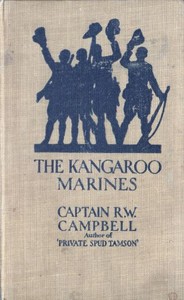
The Kangaroo Marines — Themes and Context
(0 User reviews)
731
Project Gutenberg
2008
Not confirmed
War stories; Great Britain. Army. Australian and New Zealand Army Corps -- Fiction; World War, 1914-1918 -- Australia -- Fiction; World War, 1914-1918 -- New Zealand -- Fiction; New Zealanders -- Foreign countries -- Fiction; Australians -- Foreign countries -- Fiction
Readers of public-domain and historical texts
Project Gutenberg digital edition
en
Edition facts
Words
31,156
Reading time
136 min
Text sections
4
The catalog record for The Kangaroo Marines — Themes and Context provides practical reading context through 31,156 words, 2 hr 16 min estimated reading time, and 4 detected text sections.
The text analysis averages about 12.0 words per sentence, while the detected sections provide another way to judge how the source is divided.
Project Gutenberg metadata also associates the work with “War stories,” connecting these edition facts with the source record’s subject description.
Source:
Project Gutenberg record #25452
An editorial note on R. W. Campbell's The Kangaroo Marines, focusing on its episodic structure, recurring images of blood and steel, and swift movement between Melbourne, Egypt, and the Gallipoli landing. The note draws on the preface, recruitment notice, and battle excerpt to examine how the author blends fiction with firsthand observation.
Editorial Edition Score
4.5/5
★★★★★
★★★★★
Calculated from edition completeness, EPUB availability, text structure and catalogue metadata. Not a user rating.
How this score is calculated
- Description quality20 pts
- Title & short description10 pts
- Source metadata20 pts
- Text length15 pts
- Chapters / structure15 pts
- EPUB file integrity20 pts
Total of 100 points, scaled to a 2.5-5.0 range. Editions with an empty description or a missing EPUB file are not scored.
Edition quality
Public-domain source text
Read the source text
The source text is kept in the dedicated reader, separate from this catalogue record and its commentary.
The Kangaroo Marines opens with a mock-recruitment notice calling for “cheerful toughs” and warning off “boosers, scrimshankers and loonies.” That irreverent voice, part larrikin and part recruiting sergeant, sets the tone for a narrative that shuttles between Australian barracks, Egyptian camps, and the Dardanelles beaches. R. W. Campbell, a Scottish journalist who served with Australasian forces, frames his story as “an inspiration of the Dardanelles” rather than an official history. The result is a work that moves in quick, scene-based jumps—from a pub quarrel in Melbourne to a squatter’s station, then to the chaos of the landing—held together by a small cast of recurring characters and a persistent focus on the physical shock of combat.
From Recruiting Notice to Battlefield: The Work’s Episodic Structure
The book is divided into eleven short chapters, each functioning almost like a standalone vignette. The opening chapter, “A Notable Quartette,” introduces four main characters through a bar-room argument about Sydney versus Melbourne—a scene that could belong to a colonial comedy. By Chapter VII the same men are wading ashore under Turkish machine-gun fire. Campbell does not build a continuous plot; instead he cuts from training-ground banter to a love-interest episode (“Sybil, the Squatter’s Girl”) to the landing itself. The effect is that of a sketchbook rather than a novel. Readers should expect abrupt transitions and a reliance on dialogue and action rather than psychological depth. The structure mirrors the author’s stated aim: to “picture what like these warring Bohemians are” by stringing together representative moments.
Recurring Images: Blood, Steel, and the Cold Morning Bayonet
Campbell returns obsessively to the sight of blood on bayonets and the physical sensation of cold steel. In the landing scene, “the morning light showed the red blood on the bayonets and hands of the charging men,” and the narrator notes that “the bayonet on a cold morning is a sight that sickens the best.” This image recurs across the excerpts: a subaltern’s blood “spurting in a stream,” a Turk’s skull crushed by a rifle butt, and cries for stretcher-bearers. The author uses these details not for gore but to underline the raw, unmediated violence of close-quarters fighting. The preface’s claim that Anzac is “the grim expression of a faith that is everlasting” is undercut by the text’s own emphasis on bodily shock—men who “fell, wounded, on the way” and the “awful shriek of death.”
Movement Between Scenes: From Melbourne to the Dardanelles
The narrative geography is as jumpy as its structure. Chapter II is set in Melbourne, Chapter III in “The Land of Sin” (Cairo), and Chapter VII on the Gallipoli beach. Campbell telescopes travel: characters appear in Egypt without explanation of the voyage, and the landing itself begins with a terse “Not much doing—eh?” from Colonel Killem. The author relies on the reader’s familiarity with the Anzac campaign to fill the gaps. What matters is not the journey but the contrast of settings—the easygoing bravado of the recruiting office versus the “murderous rifle and machine-gun fire” on the shore. This swift movement reinforces the sense of dislocation that soldiers experienced, but it also means the book assumes prior knowledge of the campaign’s geography and chronology.
The Author’s Position: Scot, Journalist, Imperialist
Campbell’s preface declares he is “not an Australasian, I am a Scot,” and that he holds “no special brief for the folks down under.” Yet he writes as an imperialist who lived in Australia and New Zealand, worked on Sydney and Auckland newspapers, and met political leaders. This outsider-insider perspective shapes the book’s tone: admiring but not sentimental, detailed but occasionally patronising. The preface’s call for “a say in settling affairs” in the Empire frames the story as a political argument as much as a tale of adventure. Readers should note that the author’s firsthand experience of the Dardanelles campaign gives the battle scenes a reporter’s eye for specific detail—the current that “saved thousands of Australian lives,” the confusion of mixed units, the “game which had been so well played in France.”
Because the excerpts cover only the preface, first chapter, and a portion of the landing, the full arc of the characters—especially the fates of the “notable quartette”—remains unknown. The book may well revert to the lighter tone of its opening after the battle. Readers interested in the intersection of popular fiction and wartime propaganda will find Campbell’s mixture of comedy, sentiment, and violence a revealing document of 1915 attitudes. Approach it as a period piece shaped by its author’s dual role as journalist and combatant.
The rain tapping the window kept time with the book’s staccato chapters, blood and steel ringing between Melbourne and Gallipoli. When I set it down, my fingers found another shelf entirely—a quiet, unassuming volume of notes on Aspasia. Odd, that shift from soldiering to philosophy, yet both felt like echoes of the same searching. Aspasia — Reading Notes waits there still, a calmer mirror to that restless afternoon.
There are no reviews for this eBook.
There are no comments for this eBook.
Reader reflection
Take a moment to reflect on this book
Create a short personal record of your experience with this book.
Your progress
0
/
10
2
How much did you enjoy the reading experience?
3
Would you recommend this book to another reader?
4
How demanding did the text feel?
5
Would this book work well in a reading group?
6
Is this a title worth rereading?
7
Did anything about the book feel genuinely new?
8
Did any part of the book stay with you emotionally?
9
What is the main idea you are taking away?
10