1

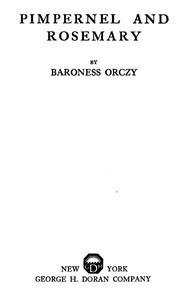
Pimpernel and Rosemary — Context and Discussion
(0 User reviews)
502
Project Gutenberg
2021
Not confirmed
Historical fiction; France -- History -- Revolution, 1789-1799 -- Fiction; Adventure stories; British -- France -- Fiction; Blakeney, Percy, Sir (Fictitious character) -- Fiction
Readers of public-domain and historical texts
Project Gutenberg digital edition
en
Edition facts
Words
111,552
Reading time
486 min
Text sections
10
This digital edition of Pimpernel and Rosemary — Context and Discussion is described by source-level measurements including 111,552 words, 8 hr 6 min estimated reading time, and 10 detected text sections.
The text analysis averages about 16.2 words per sentence, while the detected sections provide another way to judge how the source is divided.
Project Gutenberg metadata also associates the work with “Historical fiction,” connecting these edition facts with the source record’s subject description.
Source:
Project Gutenberg record #65591
In 1916 France, a woman hides messages in soldiers' tunics, linking the Scarlet Pimpernel's legacy to World War I espionage. Orczy contrasts war-torn Guillaumet with a Hungarian country estate, where Lady Tarkington faces a moral dilemma amid gaiety and gipsy music.
Editorial Edition Score
4.8/5
★★★★★
★★★★★
Calculated from edition completeness, EPUB availability, text structure and catalogue metadata. Not a user rating.
How this score is calculated
- Description quality20 pts
- Title & short description10 pts
- Source metadata20 pts
- Text length15 pts
- Chapters / structure15 pts
- EPUB file integrity20 pts
Total of 100 points, scaled to a 2.5-5.0 range. Editions with an empty description or a missing EPUB file are not scored.
Edition quality
Public-domain source text
Read the source text
The source text is kept in the dedicated reader, separate from this catalogue record and its commentary.
The novel opens in July 1916, in the ruined French village of Guillaumet, where a woman sits stitching messages into khaki tunics by lamplight. The room has a partially fallen ceiling, no roof, and tattered curtains—a setting that immediately establishes the precariousness of wartime life. The woman, Alice, is discovered by Lucien, a porter attached to an American hospital, whose dry sarcasm hints at hidden purposes. This prologue grounds the story in concrete, sensory detail: the flickering oil lamp, the rickety table, the woman's ragged bodice and unruly hair. Orczy uses the physical act of sewing to introduce secrecy and risk, while the ruined architecture underscores the fragility of the characters' world.
From Ruined Rooms to Hungarian Estates
The narrative moves abruptly from the bombed-out interiors of Guillaumet to the opulent setting of a Hungarian country estate. Where the prologue dwells on broken ceilings and missing roof tiles, later chapters describe luncheons, tennis, and gipsy musicians arriving from Bonczhida. This structural shift is not merely scenic; it creates a jarring contrast between the scarcity of war and the abundance of peacetime leisure. The same author who described a woman stitching in a half-collapsed room also writes of lobster à l'Américaine and Charlotte Russe Créole. The reader is left to bridge the gap between these worlds, wondering how the prologue's covert action connects to the gaiety of the Hungarian household.
Stitching as a Recurring Motif
The prologue's sewing scene is not an isolated image. The woman's hands are described in precise, repetitive motion: she takes up tunics, looks them over, pats them, undoes lining, inserts something small and white, and stitches again. This meticulous process mirrors the novel's own method of embedding secrets within ordinary actions. Later, when Rosemary prepares for the fateful day, she decides to "shed her real personality" and become the "dear Lady Tarkington"—a kind of psychological stitching, where she hides her true self beneath a social facade. The motif of concealment—whether in cloth or in character—runs through the excerpts, linking the physical act of hiding to the emotional labor of performing normalcy.
The Weight of Objects and Interiors
Orczy pays close attention to the material world. In the prologue, the lamp, the tunics, the scissors, and the fold in the woman's dress are all described with care. Later, the Hungarian estate is filled with menus, guest-rooms, tennis balls, and iced drinks. These objects are not mere decoration; they carry the weight of the characters' concerns. When Anna explains Hungarian stoicism, she does so while sitting beside Rosemary on a sofa, holding her hand. The physical proximity and the domestic setting ground philosophical discussion in tangible reality. The novel's structure alternates between cramped, damaged spaces and expansive, well-appointed rooms, using architecture and furnishings to signal shifts in mood and stakes.
Voices of Fatalism and Faith
Dialogue in the excerpts often serves to articulate cultural or personal philosophy. Anna's explanation of Hungarian fatalism—"We hold our lives cheap... because throughout our history we have always had to sacrifice them for our country"—is delivered in a gentle, reflective tone. Rosemary's internal response, recalling a New Testament passage about becoming as little children, shows her wrestling with the contrast between childlike faith and rational religion. These exchanges are not plot-driven; they are moments of stillness where the characters reflect on their own motivations. The novel uses such conversations to deepen the psychological landscape, even as the action moves toward a crisis that will test the resolve of everyone involved.
Readers should attend to the way Orczy builds suspense through contrast—between ruined and intact spaces, between secrecy and sociability, between the prologue's covert stitching and the later public performances of hospitality. The excerpts offer only fragments of the larger story, but they reveal a writer attentive to the physical details of her settings and the inner lives of her characters. The novel rewards those who notice how objects and architecture carry meaning, and how the characters' words often mask as much as they reveal.
That bit in Orczy’s book—where quiet sewing carries secrets across a battlefield—stayed with me long after. It reminded me of another story's weight, the slow, patient dread of lives shaped by forces they can’t quite name. Sometimes a novel lingers not for its plot, but for its ache. For the Term of His Natural Life — A Reader’s Guide holds that same textured sorrow, a companion for the thoughts you haven’t yet sorted through.
There are no reviews for this eBook.
There are no comments for this eBook.
Reader reflection
What was your reading experience?
Capture what you thought, learned, and would like to remember.
Your progress
0
/
10
2
Was reading this book enjoyable?
3
Would you pass this book on to a friend?
4
What was the reading difficulty like?
5
Did the book deliver what you hoped for?
6
Did the story or argument move comfortably?
7
Would you like to discuss this book with someone?
8
What did you appreciate most?
9
What did this book teach you most?
10