1

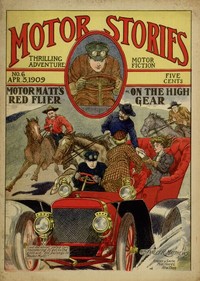
Motor Matt's Red Flyer; or, On the High Gear Motor Stories Thrilling Adventure Motor Fiction No. 6, April 3, 1909 — Edition Insights
(0 User reviews)
857
Project Gutenberg
2014
1909
Adventure stories; Automobiles -- Juvenile fiction; Dime novels; Arizona -- Juvenile fiction; Actors -- Juvenile fiction; Mechanics -- Juvenile fiction
Readers of public-domain and historical texts
Project Gutenberg digital edition
en
Edition facts
Words
36,579
Reading time
160 min
Text sections
4
The source record for Motor Matt's Red Flyer; or, On the High Gear Motor Stories Thrilling Adventure Motor Fiction No. 6, April 3, 1909 — Edition Insights measures this digital text at 36,579 words, 2 hr 40 min estimated reading time, and 4 detected text sections.
The text analysis averages about 13.6 words per sentence, while the detected sections provide another way to judge how the source is divided.
Project Gutenberg metadata also associates the work with “Adventure stories,” connecting these edition facts with the source record’s subject description.
Source:
Project Gutenberg record #47491
This editorial note examines how the opening, middle, and later excerpts of Motor Matt's Red Flyer guide a first reading, focusing on the stranded theatrical troupe, the use of dialect, and the interplay between cars and characters.
Editorial Edition Score
4.6/5
★★★★★
★★★★★
Calculated from edition completeness, EPUB availability, text structure and catalogue metadata. Not a user rating.
How this score is calculated
- Description quality20 pts
- Title & short description10 pts
- Source metadata20 pts
- Text length15 pts
- Chapters / structure15 pts
- EPUB file integrity20 pts
Total of 100 points, scaled to a 2.5-5.0 range. Editions with an empty description or a missing EPUB file are not scored.
Edition quality
Public-domain source text
Read the source text
The source text is kept in the dedicated reader, separate from this catalogue record and its commentary.
The story opens with a commotion: Topsy, a character from a stranded “Uncle Tom” company, screams that Uncle Tom is drowning in a river. The dialogue is rendered in heavy dialect (“Help! Some ob yo' folks ahead, dar!”), immediately signaling that the narrative will rely on exaggerated speech patterns to distinguish characters. The chapter title, “Stranded ‘Uncle Tommers,’” hints at a theatrical troupe in distress, and the opening crisis—a dropped box and a man overboard—plunges the reader into physical action without preamble. This excerpt establishes that Motor Matt, the hero, will be drawn into helping a group of performers, setting up a pattern of rescue and mechanical problem-solving that recurs throughout the text.
Dialect as Character Marker
The excerpts feature multiple dialects: Topsy’s exaggerated African American vernacular, Josh’s street slang (“Yous is a jim dandy, Matt!”), and Carl Pretzel’s German-accented English (not shown here but listed in the characters). These are not subtle; they are performative and intended to signal social roles quickly. For a first reader, the dialect can be challenging, but it also provides clues about each character’s background and comic function. Topsy’s lines are frantic and repetitive, while Josh’s speech is peppered with admiration and colloquialisms. The author uses these voices to create a sense of variety and to differentiate the many characters introduced in rapid succession.
The Automobile as a Central Prop
The Red Flier—a red automobile—is more than a vehicle; it is the story’s engine. Matt’s expertise with cars is evident when he tightens a loose gasoline-tank cap mid-chase, noting that rattling makes him nervous. The car is stolen, recovered, and used for pursuit. In the later excerpt, Matt switches to a faster runabout to catch thieves, demonstrating his tactical thinking. The physical details—low gear, tail lamp, spark advance—ground the adventure in mechanical reality. A reader unfamiliar with early automobiles will still grasp the urgency of speed and repair, as the narrative treats the car almost as a living ally.
Pacing Through Pursuit and Dialogue
The excerpts alternate between breathless action and banter. In the opening, Topsy’s panic creates immediate tension. Later, Matt and Josh’s exchange while driving (“De quicker we kin go de better”) maintains momentum, while the sudden appearance of Spangler on foot introduces a surprise obstacle. The dialogue is clipped and functional, often punctuated by exclamations (“Yi-yip-ee!”). This rhythm—crisis, brief explanation, then renewed chase—is typical of serial adventure fiction. First readers should expect short chapters that end on cliffhangers, as indicated by the chapter list: “A Mysterious Disappearance,” “Spirited Away,” “A Close Call.”
The Theatrical Troupe as a Source of Chaos
The stranded “Uncle Tommers” are not fully developed characters but rather a source of comic relief and complication. Their names—Legree, Little Eva, Topsy—are taken directly from Uncle Tom’s Cabin, but the story does not engage with the original novel’s themes. Instead, the troupe’s predicament (stranded, broke, losing props) provides a reason for Matt to intervene. The note that “Little Eva” turns out to be other than appearances suggests a twist, but the excerpts do not reveal it. For a first reader, the troupe’s presence adds color and unpredictability, though their dialect may feel dated or stereotypical.
As you read, pay attention to how Matt’s mechanical skill and quick thinking drive the plot forward. The cars are not just transportation; they are prizes, weapons, and sources of tension. The heavy dialect may slow you down at first, but it rewards careful reading by revealing character alliances and comic timing. This is a fast-paced serial where every chapter ends with a hook—so expect to be pulled along at high gear.
There’s something about a stranded troupe that stays with you, the way Motor Matt’s Red Flyer kept its characters moving even when stuck. That quiet tension between motion and waiting reminded me of a book that lingered on my shelf, The Way of an Eagle — Background and Themes, where the characters carry their own heaviness. I found myself thinking about that long after I set it down.
There are no reviews for this eBook.
There are no comments for this eBook.
Reader reflection
Record your reading impressions
A brief reflection can help important ideas stay with you longer.
Your progress
0
/
10
2
Was reading this book enjoyable?
3
Would you pass this book on to a friend?
4
How easy was the book to follow?
5
Did the book give you something worth debating?
6
Did this book create an emotional response?
7
What did you think about the pace?
8
How distinctive were its ideas or approach?
9
What is the main idea you are taking away?
10