1

Modern literature: a novel, Volume 3 (of 3) — Story, Setting & Ideas
(0 User reviews)
1997
Project Gutenberg
2022
Not confirmed
England -- Social life and customs -- 18th century -- Fiction
Readers of public-domain and historical texts
Project Gutenberg digital edition
en
Edition facts
Words
44,619
Reading time
194 min
Text sections
10
The catalog record for Modern literature: a novel, Volume 3 (of 3) — Story, Setting & Ideas provides practical reading context through 44,619 words, 3 hr 14 min estimated reading time, and 10 detected text sections.
The text analysis averages about 27.6 words per sentence, while the detected sections provide another way to judge how the source is divided.
Project Gutenberg metadata also associates the work with “England -- Social life and customs -- 18th century -- Fiction,” connecting these edition facts with the source record’s subject description.
Source:
Project Gutenberg record #68917
Robert Bisset's 1804 novel satirizes 18th-century English society through a journey exposing Methodism, gambling, and hack journalism. The third volume follows Hamilton and companions to Windsor, Oxford, and Bath, with sharp observations on religious hypocrisy and the literary trade.
Editorial Edition Score
4.8/5
★★★★★
★★★★★
Calculated from edition completeness, EPUB availability, text structure and catalogue metadata. Not a user rating.
How this score is calculated
- Description quality20 pts
- Title & short description10 pts
- Source metadata20 pts
- Text length15 pts
- Chapters / structure15 pts
- EPUB file integrity20 pts
Total of 100 points, scaled to a 2.5-5.0 range. Editions with an empty description or a missing EPUB file are not scored.
Edition quality
Public-domain source text
Read the source text
The source text is kept in the dedicated reader, separate from this catalogue record and its commentary.
Robert Bisset's Modern Literature, Volume 3, opens with an excursion that immediately establishes the novel's satirical method: the narrator describes Windsor Castle's prospect and the associative ideas it prompts, then shifts to a detailed account of a Methodist preacher's antics. The prose moves between elevated description and comic incident, a technique Bisset uses throughout to expose the gap between pretension and reality.
The chapter headings themselves form a kind of satirical index: 'Our Hero learns that Hamlet had been performed by the Preacher O'Rourke' and 'Affinity between the Doctrines of Methodism and Mahomedism' signal the author's willingness to pursue analogies that are as audacious as they are pointed. Bisset's diction is precise and often legalistic, reflecting his own training in law and history.
The Itinerant Preacher as Comic Antagonist
The figure of O'Rourke, the Methodist preacher who performs Hamlet and solves cases of conscience for a fee, is the novel's most fully realized satirical creation. Bisset devotes considerable space to his methods: he preaches from an inverted tub, announces collections, and drives a poor creature to despair for want of payment. The narrator's tone is one of mock-scholarly detachment, as when he notes the 'affinity between the doctrines of Methodism and Mahomedism'—a comparison that would have struck contemporary readers as deliberately provocative.
O'Rourke's eventual exposure comes through his own inconstancy: Ophelia, a woman he has converted and seduced, betrays him to the constable. The scene in which his box is searched, revealing a watch 'close by a book of spiritual hymns,' epitomizes Bisset's technique of juxtaposing the sacred and the mercenary. The preacher's escape with a silver tankard completes the portrait of religious hypocrisy as a form of theft.
The Literary Trade as a Ladder of Roguery
A long digression in the second chapter offers a systematic account of how a hack writer rises through the ranks of Grub Street. Bisset traces the career from 'porter's boy in the vestibule of the muses' to 'printer's devil' to compositor, then to magazine contributor, reviewer, and finally 'Editor Atall.' The satire is precise: the novice begins by recording runaway horses and damaged chaises, graduates to naming court attendees by bribing yeomen of the guards, and eventually becomes a parliamentary reporter and 'political philosopher.'
The passage is notable for its concrete detail: the 'Jews's Harp' tavern, the 'Garrick's Head' as a gathering place for players, the method of 'fetch and carry for Blackball.' Bisset's own experience as a historian and controversialist gives this section an insider's authority. The cumulative effect is to reduce literary production to a series of mechanical operations, devoid of genius or learning.
Setting as Satirical Device: Windsor, Oxford, Bath
The journey structure allows Bisset to contrast places with their inhabitants. Windsor Castle prompts reflections on 'association of ideas' and the royal family on their private grounds, but the narrative quickly moves to the disorder of a Methodist camp meeting. Oxford is seen 'in the dusk of the evening,' a phrase that suggests both the beauty of the city and the obscurity of its intellectual life. Blenheim Palace and the 'Fair Maid of the Inn' are mentioned only in passing, as if the narrator is impatient to reach the next scene of folly.
Bath receives the most extended treatment: its 'charming situation' and 'charitable institutions' are acknowledged, but the town is condemned as 'too much a scene of gambling and Methodistical adventurers.' The parallel between the two classes—gamblers and Methodists—is drawn explicitly: 'principle of these two classes the same.' The fashionable clergyman Parson Gilliflower, who dramatizes the pulpit and substitutes 'action and spouting' for learning, is a local specimen of the national disease.
Diction and the Rhetoric of Exposure
Bisset's prose is characterized by a lawyerly precision that turns to irony through accumulation. He uses Latinate vocabulary ('nomenclator,' 'novitiate,' 'itinerancy') to describe low subjects, creating a mock-heroic effect. The sentence 'He is able to fetch and carry for Blackball, and besides his periodical labours can venture a little in the anecdote way' mimics the very hackwork it condemns, with its loose coordination and vague quantifiers.
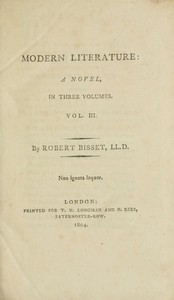
Dialogue is rare in the excerpts; the satire is carried by the narrator's voice, which shifts from lofty generalization to specific anecdote. The phrase 'Non ignota loquor' (I speak of things not unknown) on the title page signals the author's claim to insider knowledge. Bisset's method is to describe a system so thoroughly that the reader recognizes its absurdity without needing explicit judgment. The recurring motif of the 'box'—the preacher's box of tricks, the printer's box of type—suggests a world of compartments and categories that the novel itself seeks to open and expose.
Readers approaching Volume 3 should attend to the way Bisset uses the journey as a frame for social anatomy. The novel's energy lies not in plot but in the accumulation of satirical instances, each one a variation on the theme of hypocrisy. The author's own position—a historian and controversialist writing against the literary and religious fashions of his day—gives the satire a particular edge. Those interested in the period's debates about Methodism, the press, and the decline of learning will find here a rich, if partisan, source.
Reading about Hamilton’s weary passage through Bath, I remembered sitting on a grey train platform, halfway through a novel that felt like watching someone else’s polite life from a window. The same quiet absurdity surfaced in In the Cage — Edition Insights, where every glance between strangers feels weighted with unspoken rules. Neither book rushes; they just let the world’s small hypocrisies settle, like dust on a sill.
There are no reviews for this eBook.
There are no comments for this eBook.
Reader reflection
Take a moment to reflect on this book
Create a short personal record of your experience with this book.
Your progress
0
/
10
2
How much did you enjoy the reading experience?
3
Would you recommend this book to another reader?
4
How much effort did this book require?
5
Did the book meet your expectations?
6
Would you start a conversation about this book?
7
Which element worked best for you?
8
How useful were the ideas in this book?
9
What changed or sharpened your thinking?
10