1

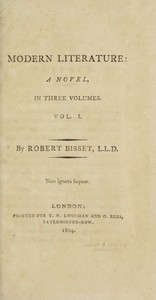
Modern literature: a novel, Volume 1 (of 3) — A Reader’s Guide
(0 User reviews)
752
Project Gutenberg
2022
Not confirmed
England -- Social life and customs -- 18th century -- Fiction
Readers of public-domain and historical texts
Project Gutenberg digital edition
en
Edition facts
Words
52,648
Reading time
229 min
Text sections
14
For Modern literature: a novel, Volume 1 (of 3) — A Reader’s Guide, the stored edition analysis reports 52,648 words, 3 hr 49 min estimated reading time, and 14 detected text sections.
The text analysis averages about 25.2 words per sentence, while the detected sections provide another way to judge how the source is divided.
Project Gutenberg metadata also associates the work with “England -- Social life and customs -- 18th century -- Fiction,” connecting these edition facts with the source record’s subject description.
Source:
Project Gutenberg record #68915
Robert Bisset's 1804 novel opens with a preface defending its general satire, then follows Hamilton, a Cambridge senior wrangler, as he navigates London's literary marketplace and a fraught reunion with Jenny Collings.
Editorial Edition Score
4.8/5
★★★★★
★★★★★
Calculated from edition completeness, EPUB availability, text structure and catalogue metadata. Not a user rating.
How this score is calculated
- Description quality20 pts
- Title & short description10 pts
- Source metadata20 pts
- Text length15 pts
- Chapters / structure15 pts
- EPUB file integrity20 pts
Total of 100 points, scaled to a 2.5-5.0 range. Editions with an empty description or a missing EPUB file are not scored.
Edition quality
Public-domain source text
Read the source text
The source text is kept in the dedicated reader, separate from this catalogue record and its commentary.
The preface to Robert Bisset's Modern Literature (1804) directly addresses a recurring complaint against satirical fiction: that readers mistake general characters for specific individuals. Bisset recounts how his earlier Highlander was misapplied to dozens of people he had never intended, and insists he has now "so to assort and mingle features, as to prevent any approach to individuality." Yet he concedes the difficulty of drawing character without borrowing lines from actual persons. This defensive preamble frames the novel as a deliberate, if cautious, commentary on literary and social types.
The story proper introduces Hamilton, a Cambridge senior wrangler who arrives in London to study law. His past catches up with him when Jenny Collings, a young woman he had seduced, appears at his chambers. Their reunion scene—marked by her faint, his protestations, and her account of a broken-hearted mother—establishes a pattern of moral consequence and economic anxiety that runs through the volume.
A Preface That Foregrounds the Satirical Method
Bisset's preface is unusual in its length and defensiveness. He claims his purpose is "fair and impartial" and "general, without any satirical allusion to individual characters," yet he immediately undermines this by noting that several people claimed to be the targets of his earlier work. The preface thus becomes a document of the very problem it describes: the impossibility of writing social satire without being read as personal attack. Bisset's solution—mixing features from multiple sources—is presented as a safeguard, but the reader may wonder whether the novel's characters are as blended as he asserts. The preface also reveals Bisset's awareness of his audience's appetite for scandal: "the food of vanity is notoriety," he writes, and a vain person will pretend to be satirized in order to become "the subject of talk." This meta-commentary on reading practices is the most intellectually engaging part of the opening.
Hamilton's Cambridge Success and London Prospects
The narrative quickly sketches Hamilton's academic triumph: he becomes senior wrangler, "the highest that a bachelor of arts can reach," and is deemed "one of the ablest and most promising young men that Cambridge had raised." This achievement is presented without irony, but the novel's title—Modern Literature—suggests that intellectual promise will be tested by the literary marketplace. Hamilton himself acknowledges this when he tells Jenny, "I understand there is a considerable market for literary efforts in this place; I am not without hopes of rising by such exercises." The phrase "market for literary efforts" is telling: writing is here a commercial venture, not a calling. The novel thus sets up a tension between the ideal of scholarly merit (symbolized by the wrangler's honor) and the reality of earning a living through words in London.
Jenny Collings and the Economics of Seduction
Jenny Collings's arrival at Hamilton's chambers is the volume's most dramatic scene. Her narrative of discovery and flight is detailed and poignant: she had been her widowed mother's chief hope, her fall "blasted all her expectations," and her mother's silent tears drove her to leave home with six guineas saved from gifts. The money—exactly half left in a farewell letter—is a concrete detail that grounds the scene in economic reality. Jenny's anxiety about Hamilton's intentions is equally material: she asks directly whether he means marriage or mere maintenance, and when he offers to share "the fruits of my labours," she interprets this as an insult. The scene ends with her hysterical cry, "I am ruined, but wi..." (the text breaks off). The excerpt shows Bisset's willingness to depict the consequences of seduction in financial and emotional terms, without moralizing abstraction.
Readers should note that the excerpts cover only the preface and the opening chapters. The catalog subject "England -- Social life and customs -- 18th century -- Fiction" is broadly accurate, but the novel's focus on literary professions and the economics of writing is more specific than that heading suggests. The preface's concern with misreading may also color how one interprets later characters: Bisset warns us not to look for originals, yet the warning itself invites the search.
Sometimes a book stays with you less for its plot than for the quiet ache underneath. Hamilton’s careful steps through London felt like that, a gentle loneliness in crowded rooms. The Unbearable Bassington — Themes and Context reminded me of the same weight, that strange space between wanting to belong and watching yourself drift. I think of them both sometimes, like old, unresolved letters.
There are no reviews for this eBook.
There are no comments for this eBook.
Reader reflection
Take a moment to reflect on this book
Create a short personal record of your experience with this book.
Your progress
0
/
10
2
How did the book work for you overall?
3
Would you pass this book on to a friend?
4
How much effort did this book require?
5
Did it raise ideas you would like to talk about?
6
Was the book easy to understand?
7
Was the book moving at the right speed?
8
How strongly did the book affect you emotionally?
9
What did this book teach you most?
10