1

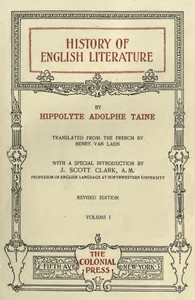
History of English Literature Volume 1 (of 3) — Text and Context
(0 User reviews)
1733
Project Gutenberg
2020
Not confirmed
English literature -- History and criticism
Readers of public-domain and historical texts
Project Gutenberg digital edition
en
Edition facts
Words
174,992
Reading time
761 min
Text sections
24
This digital edition of History of English Literature Volume 1 (of 3) — Text and Context is described by source-level measurements including 174,992 words, 12 hr 41 min estimated reading time, and 24 detected text sections.
The text analysis averages about 21.5 words per sentence, while the detected sections provide another way to judge how the source is divided.
Project Gutenberg metadata also associates the work with “English literature -- History and criticism,” connecting these edition facts with the source record’s subject description.
Source:
Project Gutenberg record #61308
Taine's 1864 critical history examines English literature through the lens of race, milieu, and epoch, using vivid metaphors and close readings of Chaucer, Shakespeare, and Spenser. This volume covers from Anglo-Saxon origins to the Elizabethan era, emphasizing how historical forces shape literary expression.
Editorial Edition Score
4.9/5
★★★★★
★★★★★
Calculated from edition completeness, EPUB availability, text structure and catalogue metadata. Not a user rating.
How this score is calculated
- Description quality20 pts
- Title & short description10 pts
- Source metadata20 pts
- Text length15 pts
- Chapters / structure15 pts
- EPUB file integrity20 pts
Total of 100 points, scaled to a 2.5-5.0 range. Editions with an empty description or a missing EPUB file are not scored.
Edition quality
Public-domain source text
Read the source text
The source text is kept in the dedicated reader, separate from this catalogue record and its commentary.
Taine opens this first volume with a dedication to Guizot and a methodological preface that sets the stage for a sweeping analysis of English literature as a product of racial character, historical moment, and physical environment. The translation by Henri Van Laun preserves Taine's distinctive voice—at once analytical and lyrical—as he moves from Anglo-Saxon poetry to the Elizabethan playwrights. The special introduction by J. Scott Clark, added for this edition, frames Taine's work as a landmark in American education, though the core of the book remains Taine's own argument that literary works are not isolated artifacts but symptoms of deeper cultural and psychological currents.
Taine’s Method: Race, Milieu, and the Organic Metaphor
Taine repeatedly compares literary development to natural growth. In his discussion of Spenser, he describes the poet's imagination as a "mental growth" where "at every instant a bud shoots forth, and on this another and still another; each producing, increasing, blooming of itself." This organic metaphor extends to entire literary periods, which Taine treats as living organisms shaped by three forces: race (the inherited disposition), milieu (the surrounding social and physical conditions), and epoch (the historical moment). The method is deterministic but not reductive; Taine insists that great writers both express and transcend their circumstances. His analysis of Chaucer, for instance, ties the poet's genial realism to the relative stability of fourteenth-century England, while Shakespeare's turbulent energy reflects the violent contradictions of the Renaissance.
The Movement from Medieval to Renaissance
Taine structures this volume as a journey from the "primitive" vigor of Anglo-Saxon verse through the chivalric ideals of the Middle Ages to the "sublime sharp summit" of the Elizabethan era. He lingers on the transition, noting how the religious certainties of the medieval period give way to a more complex, self-conscious artistry. In his treatment of Spenser, Taine highlights the poet's ability to hold pagan and Christian elements in balance: "We touch here the sublime sharp summit where the world of mind and the world of sense unite; where man, gathering with both hands the loveliest flowers of either, feels himself at the same time a pagan and a Christian." This passage exemplifies Taine's method of using a single author to epitomize a broader cultural synthesis.
Recurring Images: Light, Vapor, and the Inexhaustible Stream
Throughout the excerpts, Taine returns to images of light and flowing water to describe creative energy. Spenser's imagination is likened to "vapors which rise incessantly from the sea, ascend, sparkle, commingle their golden and snowy scrolls," while the poet himself remains "calm in the fervor of invention." This contrast between the turbulent subject and the serene observer recurs in Taine's portraits of other writers. Shakespeare, by contrast, is associated with "sharp, piercing, concentrative words" and "sudden accumulations." The imagery of light also appears in the discussion of Spenser's Platonic love, where the beloved's "celestiall ray" is "a parcell of the purest skie." Taine uses these visual metaphors to bridge abstract literary theory and concrete textual detail.
Structure and the Role of the Translator
Henri Van Laun's translation, first published in 1872, renders Taine's French prose into an English that retains the original's rhythmic cadences and periodic sentences. The volume is divided into chapters that follow a chronological arc, but within each chapter Taine moves freely between biographical anecdote, textual quotation, and sweeping generalization. The result is a work that reads less like a textbook than a series of critical essays linked by a coherent argument. Readers should note that Taine's quotations from English poets are often given in the original, with his commentary weaving around them. This structure invites the reader to test Taine's claims against the evidence of the poems themselves, making the volume a dialogue between critic and text.
This edition, part of the World's Great Classics Library, includes photogravure illustrations and a frontispiece depicting Shakespeare before Sir Thomas Lucy—a visual cue that underscores Taine's interest in the biographical and historical contexts of literature. Readers approaching this volume should be prepared for a critic who is as much a stylist as a scholar, one who uses metaphor and analogy to illuminate his subject. Taine's History remains a provocative entry point into the study of English literature, even as its deterministic framework has been challenged by later critics.
Taine’s insistence that a writer is a product of his time always lingers with me—I find myself half-wondering what circumstances shaped my own reading habits. Then I think of his English poets and, gently, of their American counterparts, whose voices carried a different wilderness entirely. It feels like a quiet, unfinished conversation between the two volumes. History of American Literature — Inside the Classic sits nearby, patient, as if waiting for me to open it.
There are no reviews for this eBook.
There are no comments for this eBook.
Reader reflection
What was your reading experience?
Capture what you thought, learned, and would like to remember.
Your progress
0
/
10
2
What was your overall reaction to the book?
3
Would you encourage someone else to read it?
4
What was the reading difficulty like?
5
Did the story or argument move comfortably?
6
How strongly did the book affect you emotionally?
7
Would this book work well in a reading group?
8
How distinctive were its ideas or approach?
9
Which lesson or insight stayed with you?
10