1

Gleanings from the Harvest-Fields of Literature: A Melange of Excerpta — Reading Companion
(0 User reviews)
82
Project Gutenberg
2018
Not confirmed
Literary curiosa; Literature -- Dictionaries
Readers of public-domain and historical texts
Project Gutenberg digital edition
en
Edition facts
Words
277,412
Reading time
1207 min
Text sections
88
For Gleanings from the Harvest-Fields of Literature: A Melange of Excerpta — Reading Companion, the stored edition analysis reports 277,412 words, 20 hr 7 min estimated reading time, and 88 detected text sections.
The text analysis averages about 20.3 words per sentence, while the detected sections provide another way to judge how the source is divided.
Project Gutenberg metadata also associates the work with “Literary curiosa,” connecting these edition facts with the source record’s subject description.
Source:
Project Gutenberg record #56805
A 19th-century miscellany of literary curiosities, quotations, and odd facts compiled by C. C. Bombaugh, drawing from sources like Montaigne and Shakespeare, with catalog subjects 'Literary curiosa' and 'Literature -- Dictionaries' that accurately reflect its patchwork nature.
Editorial Edition Score
4.9/5
★★★★★
★★★★★
Calculated from edition completeness, EPUB availability, text structure and catalogue metadata. Not a user rating.
How this score is calculated
- Description quality20 pts
- Title & short description10 pts
- Source metadata20 pts
- Text length15 pts
- Chapters / structure15 pts
- EPUB file integrity20 pts
Total of 100 points, scaled to a 2.5-5.0 range. Editions with an empty description or a missing EPUB file are not scored.
Edition quality
Public-domain source text
Read the source text
The source text is kept in the dedicated reader, separate from this catalogue record and its commentary.
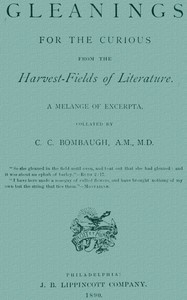
This compilation, assembled by C. C. Bombaugh in 1890, presents itself as a 'melange of excerpta'—a deliberate patchwork of quotations, anecdotes, and odd facts drawn from a wide range of sources. The title page borrows Montaigne's metaphor: 'I have here made a nosegay of culled flowers, and have brought nothing of my own but the string that ties them.' The prefatory pages gather epigraphs that liken the work to a 'running banquet,' a 'dinner of fragments,' and a 'regular omnibus' offering something for every taste. These framing devices signal that the book is not a sustained argument but a curated collection, organized around curiosity rather than chronology.
The Compiler's Self-Deprecating Frame
The opening pages are thick with borrowed apologies. Bombaugh quotes Raynald's Woman's Book to anticipate critics: 'many there are, before whose sight this Book shall finde small grace, and lesse favour.' He then strings together epigraphs from Shakespeare, Butler, Massinger, and others, each comparing the work to leftovers or a miscellany. The phrase 'a gatherer and a disposer of other men's stuff' (from Wotton) is particularly telling: it acknowledges the compiler's role as collector rather than originator. This self-deprecating stance is consistent throughout the excerpts, where Bombaugh rarely inserts his own voice. The effect is to frame the book as a humble offering of literary scraps, inviting readers to browse without expectation of unity.
Numerological Obsession in the Excerpts
One extended excerpt reveals a fascination with the number seven, tracing its significance through Hippocrates, Shakespeare, the Bible, and common law. The passage argues that 'the septenary number by its occult virtue tends to the accomplishment of all things,' then catalogs instances: seven months for a viable birth, seven years for apprenticeship, seven days of creation, seven priests at Jericho. The tone is encyclopedic and credulous, treating numerological patterns as self-evident truths. This section exemplifies the book's method: it collects examples without critical commentary, letting the accumulation of instances imply meaning. The catalog subject 'Literary curiosa' fits such content, but the excerpt shows Bombaugh's interest extends beyond literature into natural history and custom.
Structure as a 'Piece of Patchwork'
The excerpts suggest the book is organized not by theme but by associative leaps. The numerological passage appears without transition from earlier epigraphs; the text jumps from biblical exegesis to legal customs to Shakespearean references. Bombaugh's preface, quoting Guesses at Truth, defends this: 'They who cannot weave a uniform web may at least produce a piece of patchwork; which may be useful and not without a charm of its own.' The catalog subjects list 'Literature -- Dictionaries,' but the excerpts show no alphabetical or systematic arrangement. Instead, the book seems to follow the compiler's whim, grouping curiosities by loose association. Readers should expect abrupt shifts and no overarching narrative—a feature that aligns with the 'melange' promised in the title.
Bombaugh's collection rewards browsing rather than linear reading. The excerpts reveal a compiler who delights in oddities—numerological lore, obscure quotations, and forgotten customs—but offers little analysis. Readers interested in 19th-century habits of literary curation will find the prefatory material especially revealing, as it lays out the era's taste for compendiums of 'curious' knowledge. Approach the book as a cabinet of wonders, not a reference work; its value lies in the unexpected juxtapositions and the window it opens onto Victorian intellectual appetites.
This patchwork of old quotes reminds me of my grandfather’s shelf — odd volumes he’d read aloud on rainy afternoons. I found a similar feeling years later in The Victorian Age in Literature — A Closer Reading, where the era’s quirks feel less like history and more like a familiar, comfortable voice beside me.
There are no reviews for this eBook.
There are no comments for this eBook.
Reader reflection
Record your reading impressions
A brief reflection can help important ideas stay with you longer.
Your progress
0
/
10
2
How much did you enjoy the reading experience?
3
Would you recommend this book to another reader?
4
Did the language feel accessible?
5
Did anything about the book feel genuinely new?
6
Did you gain anything practical from the text?
7
Did the book deliver what you hoped for?
8
How strong was your personal connection to the text?
9
What did this book teach you most?
10