1

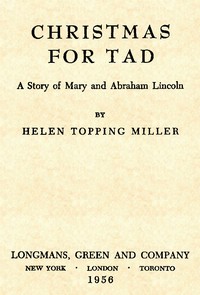
Christmas for Tad: A Story of Mary and Abraham Lincoln — Key Ideas to Explore
(0 User reviews)
82
Project Gutenberg
2021
Not confirmed
Christmas stories; Biographical fiction; Lincoln, Abraham, 1809-1865 -- Fiction; Presidents -- United States -- Fiction; Lincoln, Mary Todd, 1818-1882 -- Fiction; Lincoln, Thomas, 1853-1871 -- Fiction
Readers of public-domain and historical texts
Project Gutenberg digital edition
en
Edition facts
Words
20,561
Reading time
90 min
Text sections
3
The catalog record for Christmas for Tad: A Story of Mary and Abraham Lincoln — Key Ideas to Explore provides practical reading context through 20,561 words, 1 hr 30 min estimated reading time, and 3 detected text sections.
The text analysis averages about 13.6 words per sentence, while the detected sections provide another way to judge how the source is divided.
Project Gutenberg metadata also associates the work with “Christmas stories,” connecting these edition facts with the source record’s subject description.
Source:
Project Gutenberg record #65810
A Christmas Eve story set in 1863, focusing on Tad Lincoln's preparations and the family's intimate moments, with Abraham Lincoln's gentle humor and the White House as a domestic backdrop amid war.
Editorial Edition Score
4.5/5
★★★★★
★★★★★
Calculated from edition completeness, EPUB availability, text structure and catalogue metadata. Not a user rating.
How this score is calculated
- Description quality20 pts
- Title & short description10 pts
- Source metadata20 pts
- Text length15 pts
- Chapters / structure15 pts
- EPUB file integrity20 pts
Total of 100 points, scaled to a 2.5-5.0 range. Editions with an empty description or a missing EPUB file are not scored.
Edition quality
Public-domain source text
Read the source text
The source text is kept in the dedicated reader, separate from this catalogue record and its commentary.
The story opens with a tightly sealed package and a ten-year-old boy fidgeting while his father works at the knots with an old horn-handled knife. The scene immediately establishes a tactile, domestic intimacy: Tad’s miniature colonel’s uniform, the copper-toed boots, his father’s long, bony fingers and a thumbnail thickened by an ax mishap. The date is December 1863, and war lies like a shadow over the country, but for Tad, December means Christmas and packages mean surprises. The narrative voice moves between Tad’s impatient perspective and the father’s deliberate, drawling speech, creating a rhythm of waiting and revelation that sets the tone for the hours ahead.
A Father’s Hands and a Boy’s Impatience
The opening sequence dwells on hands and tools. Tad touches his father’s thumbnail and asks about it; Lincoln’s reply—about an ax that “didn’t want to go where I aimed it”—is a miniature parable of will and accident, told with a quirked mouth and flicking eyebrows. The knife clicks shut, the package yields its secret, but the reader is left with the image of those long, yellowed fingers and the story behind the scar. Miller uses physical detail to anchor character: Tad’s uniform is described button by button, his boots show copper toes, and his impatience is rendered through shifting weight and a whimper later in the text. These details are not decorative; they ground the historical figures in sensory reality.
The Goat, the Paint, and the Corporal’s Escort
Later, Tad’s attention shifts to his goat Billy, whose horns have been painted scarlet and tipped with brass circles by soldiers. The goat becomes a comic centerpiece: Tad cries for his lost nanny goat, the corporal apologizes for the paint, and Lincoln calmly assesses the damage to the uniform jacket. The scene moves from the White House grounds to the kitchen, with a military escort of privates whose rifles may not be loaded. Miller balances the absurdity—a president inspecting painted goat horns—with the underlying tension of wartime security. The corporal’s formal salute and Lincoln’s easy “No offense taken” show a commander who is both approachable and aware of the men’s earnest efforts.
The White House Kitchen: A Domestic Interlude
Lincoln’s entry into the kitchen is marked by hesitation: “He had never set foot in the White House kitchen. Now Abraham Lincoln walked timidly there as though he were an intruder.” The room is warm, still odorous with baking, with ranges cooling and water dripping from a pump. Miller describes the cooks’ aprons and caps on pegs, trays of small colored cakes for the Christmas party. Lincoln lifts a cloth, takes a pink cake, and then leads an impromptu foraging expedition for biscuits and jam. He slices bread, spreads blackberry jam, and passes a towel around. The scene is a quiet counterpoint to the war outside—a president perched on a table, eating jam and bread with privates, solving a goat’s diet problem with a loaf of bread.
Movement Between Scenes: From Gloom to Warmth
The narrative moves through distinct physical spaces: the closed room with the package, the grounds with the goat, the kitchen’s warmth. Each shift is marked by a change in light and mood. Outside is “the gloom of late December”; inside, the kitchen glows with cooling ranges and the smell of bread. Miller uses these transitions to contrast the weight of war with domestic rituals. The soldiers’ presence—corporal, privates, detailed to meet a train—keeps the war visible at the edges. Lincoln’s ease with the men, his willingness to whack bread and spread jam, suggests a leader who finds respite in small, tangible acts. The story’s structure relies on these movements, each scene a vignette that builds toward Christmas morning.
Readers attentive to the interplay of public and private will find in Miller’s details—the painted goat horns, the borrowed towel, the president’s thumbnail—a portrait built from small, telling moments. The story does not attempt to cover the war’s breadth; it stays close to Tad’s eye level and Lincoln’s dry humor. Approach it as a series of linked scenes rather than a continuous plot, and notice how each object—a knife, a jar of jam, a brass-tipped horn—carries the weight of character and context.
This year, as I read Christmas for Tad, I remembered a long Christmas Eve when my own father stayed up with me, fixing a toy. That quiet, domestic closeness is what The corsair; or, the little fairy at the bottom of the sea — A Reader’s Guide once gave me too—not grand adventure, but a small, private world where someone watches over you until the storm passes. Both feel like warm lamplight.
There are no reviews for this eBook.
There are no comments for this eBook.
Reader reflection
Before you leave, reflect on the book
Use these questions to collect your thoughts before moving on.
Your progress
0
/
10
2
Was reading this book enjoyable?
3
Would you pass this book on to a friend?
4
How demanding did the text feel?
5
Would you read this book again?
6
How valuable was this book for your own interests?
7
How closely did the book connect with your experience?
8
How clear did the writing feel?
9
Which lesson or insight stayed with you?
10