1

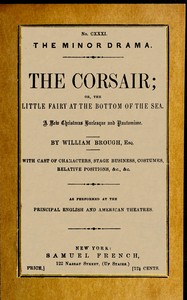
The corsair; or, the little fairy at the bottom of the sea — A Reader’s Guide
(0 User reviews)
1479
Project Gutenberg
2025
Not confirmed
Burlesques; English drama -- 19th century; Pantomime (Christmas entertainment)
Readers of public-domain and historical texts
Project Gutenberg digital edition
en
Edition facts
Words
13,894
Reading time
61 min
Text sections
9
Before opening The corsair; or, the little fairy at the bottom of the sea — A Reader’s Guide, the edition data offers a quick orientation: 13,894 words, 1 hr 1 min estimated reading time, and 9 detected text sections.
The text analysis averages about 11.4 words per sentence, while the detected sections provide another way to judge how the source is divided.
Project Gutenberg metadata also associates the work with “Burlesques,” connecting these edition facts with the source record’s subject description.
Source:
Project Gutenberg record #76960
This editorial note examines William Brough's 1856 burlesque pantomime, focusing on its parodic diction, self-aware dialogue, and stage directions that mock Byronism and theatrical conventions through puns, anachronisms, and metatheatrical asides.
Editorial Edition Score
4.6/5
★★★★★
★★★★★
Calculated from edition completeness, EPUB availability, text structure and catalogue metadata. Not a user rating.
How this score is calculated
- Description quality20 pts
- Title & short description10 pts
- Source metadata20 pts
- Text length15 pts
- Chapters / structure15 pts
- EPUB file integrity20 pts
Total of 100 points, scaled to a 2.5-5.0 range. Editions with an empty description or a missing EPUB file are not scored.
Edition quality
Public-domain source text
Read the source text
The source text is kept in the dedicated reader, separate from this catalogue record and its commentary.
William Brough's 1856 Christmas burlesque opens not with a ship or a harem but with a "Marine Aquarium, or Naiad's Coralline Temple," where water spirits are roused by tritons blowing conches. The fairy Submarina immediately calls the assembly to order: "This is a public meeting, not a ball." That line signals the play's governing mode—a knowing, deflationary humor that treats its own fantastical setting as a bureaucratic inconvenience. The cast list describes Conrad as "gloomy, misanthropical, ironical and Byronical," a self-mocking précis that primes the audience for a hero whose posturing will be punctured at every turn.
Diction as Parodic Signature
Brough's wordplay operates on multiple levels. The Pasha is named "Seyd (or Seedy) Pasha," collapsing the exotic into the shabby. Syng Smaul, the major-domo, is "Head Cook and Bottle-washer." The slave merchant Yussuf is glossed as "in his own country Joseph—or familiarly, Old Joe." These parenthetical jabs turn character names into running gags. The dialogue is dense with puns: when Conrad complains of being kept in the dark, Gulnare retorts, "Surely you'd light—those chains have lots of links." Such lines treat language as a toy, not a tool of illusion. The effect is to keep the audience at a critical distance, admiring the cleverness rather than suspending disbelief.
Metatheatrical Mechanics and Stage Business
The printed text includes extensive stage directions, entrances and exits, and relative positions—a remnant of the acting edition format. But Brough also builds metatheatricality into the dialogue. When Gulnare produces a duplicate key, Medora exclaims, "A duplicate! that is, indeed, the ticket." The phrase winks at the audience: the key is a theatrical prop, and the escape plot a contrivance. Later, Conrad says of his dungeon, "'Tis an awful cell," and Medora replies, "That loved form ironed! Well, it's saved from mangling." The bathos undercuts any potential pathos. The play constantly reminds us that we are watching a performance, not a drama.
Rhyme, Rhythm, and the Burlesque Couplet
Brough writes in rhymed couplets, but his meter is loose and his rhymes often anticlimactic or deliberately strained. Submarina's opening speech ends with "Here come, I'll take the chair—now silence, all." The flatness of "all" after the pompous buildup is typical. When Medora refuses the Pasha, she says, "I'd see him further first, and then I won't." The couplet form forces compression, and Brough exploits it for comic effect, pairing high-flown sentiment with colloquial deflation. The result is a verse style that constantly undercuts itself, mirroring the play's broader strategy of parodying the Byronic hero and the melodramatic plots it borrows from the ballet Le Corsaire.
Character as Caricature and the Limits of Evidence
The excerpts show characters who are types rather than individuals. Conrad is defined by his "ironical and Byronical" gloom, but his dialogue is full of self-deprecating asides like "I'm dished—I ask no quarter." Medora oscillates between defiance and pragmatic scheming. Gulnare, the Pasha's favorite, coolly proposes to marry the Pasha herself once Conrad is gone. The excerpts do not reveal the full resolution, so it is unclear whether the fairy Submarina or the "Little Fairy at the bottom of the sea" (Serena) intervenes in the plot. What is clear is that Brough uses character as a vehicle for parody rather than psychology, and that the play's interest lies in its verbal and theatrical play, not in narrative suspense.
Readers approaching this text should attend to its status as a performance script designed for a specific holiday audience. The puns, anachronisms, and metatheatrical jokes assume a familiarity with Byron's The Corsair and the conventions of ballet and melodrama. Brough's burlesque does not seek to improve on its sources but to expose their artificiality with affectionate irreverence. The pleasure lies in watching the machinery of theatrical illusion being taken apart and reassembled as a joke.
That afternoon the rain drummed on the windowsill while I laughed at Brough’s mocking stage directions, his pantomime gleefully dismantling Byron’s grand poses. It made me think of kindness worn like armour, and I reached afterwards for the quiet, unsettling warmth of Passing of the Third Floor Back — A Reader’s Guide, where redemption slips in unannounced, much like the weather had that day.
There are no reviews for this eBook.
There are no comments for this eBook.
Reader reflection
Before you leave, reflect on the book
Use these questions to collect your thoughts before moving on.
Your progress
0
/
10
2
How much did you enjoy the reading experience?
3
Would you recommend this book to another reader?
4
How easy was the book to follow?
5
Did the book offer a fresh perspective?
6
Is this a title worth rereading?
7
Did the book give you something worth debating?
8
Did the book deliver what you hoped for?
9
What changed or sharpened your thinking?
10