
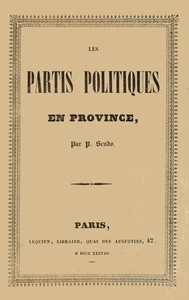
Les partis politiques en Province by Paul Scudo
Paul Scudo's Les partis politiques en Province pulls back the curtain on a chaotic and thrilling period in French history. We're in the years following the 1848 Revolution, which toppled the monarchy and established the Second Republic. But this isn't a story about Paris. Scudo turns his sharp eye to the provinces—the towns and regions far from the capital's spotlight—to see how ordinary places grappled with extraordinary political change.
The Story
The book acts as a political field report. Scudo charts the messy, energetic birth of local political parties across France. He shows us how national ideologies—republicanism, socialism, conservatism—took root in different soils, adapting to local concerns, family networks, and economic realities. It's not a dry list of policies. It's about the cafe debates, the newspaper wars, the election campaigns, and the personal ambitions that fueled these new groups. We see how the grand promises made in Paris were interpreted, fought over, and sometimes completely rewritten in places like Lyon, Marseille, or smaller rural towns. The core narrative is the struggle to build a new political order from the ground up.
Why You Should Read It
What makes this book so compelling is its immediacy. Scudo writes with the urgency of someone documenting history as it happens. You get the sense of possibility and peril that everyone felt. The characters here aren't fictional heroes, but real local leaders, journalists, and citizens trying to navigate a world where the old rules are gone. It makes you realize that major political shifts aren't just about laws and leaders; they're about countless local conversations and conflicts. Reading it today, you can't help but see parallels in how political identities form and fracture, making 19th-century France feel surprisingly familiar.
Final Verdict
This book is perfect for history buffs who want to go beyond kings and battles, and for anyone curious about the grassroots mechanics of politics. It's for the reader who enjoys biographies of ideas, watching how abstract concepts like 'republic' or 'the right to work' become real forces in people's lives. If you found Simon Schama's histories engaging or enjoy the political depth of a novel like Hilary Mantel's Wolf Hall, you'll appreciate Scudo's ground-level view of a revolution settling in. It’s a specific, insightful, and utterly human look at the making of modern France.
This work has been identified as being free of known copyright restrictions. You can copy, modify, and distribute it freely.
Barbara Anderson
2 months agoIf you're tired of surface-level information, the way it handles controversial points with balance is quite professional. I'll be citing this in my upcoming project.
Patricia Moore
5 months agoIt’s rare to find such a well-structured narrative nowadays, the cross-referencing of different chapters makes it a great study tool. Simple, effective, and authoritative – what else could you ask for?
John Brown
1 year agoRight from the opening paragraph, the author manages to bridge the gap between theory and practice effectively. If you want to master this topic, start right here.
Margaret Lopez
8 months agoThanks for the recommendation.





George Taylor
1 year agoInitially, I was looking for a specific answer, but the attention to detail regarding the core terminology is flawless. A solid investment for anyone's personal development.