1

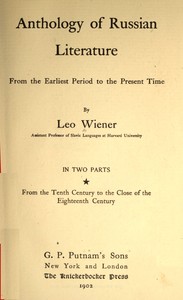
Anthology of Russian literature from the earliest period to the present time, volume 1 (of 2) — Background and Themes
(0 User reviews)
325
Project Gutenberg
2023
Not confirmed
Russian literature -- Translations into English; Russia -- Literary collections
Readers of public-domain and historical texts
Project Gutenberg digital edition
en
Edition facts
Words
162,507
Reading time
707 min
Text sections
72
The catalog record for Anthology of Russian literature from the earliest period to the present time, volume 1 (of 2) — Background and Themes provides practical reading context through 162,507 words, 11 hr 47 min estimated reading time, and 72 detected text sections.
The text analysis averages about 21.2 words per sentence, while the detected sections provide another way to judge how the source is divided.
Project Gutenberg metadata also associates the work with “Russian literature -- Translations into English,” connecting these edition facts with the source record’s subject description.
Source:
Project Gutenberg record #71933
Leo Wiener's 1902 anthology traces Russian literature from the 10th to the 18th century, with biographical sketches and extracts. The preface argues for Russian's academic place, while excerpts show satirical debates on science and social life.
Editorial Edition Score
4.9/5
★★★★★
★★★★★
Calculated from edition completeness, EPUB availability, text structure and catalogue metadata. Not a user rating.
How this score is calculated
- Description quality20 pts
- Title & short description10 pts
- Source metadata20 pts
- Text length15 pts
- Chapters / structure15 pts
- EPUB file integrity20 pts
Total of 100 points, scaled to a 2.5-5.0 range. Editions with an empty description or a missing EPUB file are not scored.
Edition quality
Public-domain source text
Read the source text
The source text is kept in the dedicated reader, separate from this catalogue record and its commentary.
Leo Wiener's 1902 anthology opens with a preface that positions Russian as a language soon to match German and French in American curricula, citing its speakers and geopolitical span. The editor's voice is direct and persuasive, aiming to fill a gap for English readers who know only nineteenth-century novels in mediocre translations. The excerpts reveal a striking shift: from the preface's scholarly advocacy to a satirical dialogue where characters mock learning. One speaker compares studying to 'making pease to stick to the wall,' while another praises wine over books, declaring he will abandon his cup only when 'swift rivers will run to their sources.' This contrast between Wiener's earnest framing and the text's ironic self-criticism sets an unusual tone for an anthology.
A Preface That Argues for Necessity
Wiener's preface is not a dry introduction but a polemic. He asserts that 'the time is not far off when the Russian language will occupy the same place in the curriculum of American universities that it now does in those of Germany, France and Sweden.' The argument rests on numbers—'more than one hundred million people'—and on political and literary contact between Anglo-Saxon and Slavic races. He criticizes existing translations as 'rarely rising above mediocrity' and promises a 'concise, yet sufficient, account of Russian Literature in its totality.' The preface thus frames the anthology as both a scholarly tool and a cultural bridge, with Wiener's own authority as Harvard professor lending weight. The language is confident, even urgent, suggesting a mission to educate an audience he considers underinformed.
Satirical Voices Against Learning
In the excerpt, a character named Sylvan praises only the science that 'teaches how to increase his income and to save expenses.' He dismisses astronomy, medicine, and geometry as useless: 'We can manage to divide the land in quarters without Euclid, and we know without algebra how many kopeks there are in a rouble.' Another speaker, Red-faced Lucas, delivers a mock encomium to wine, calling it 'a divine gift' that 'befriends people, gives cause for conversation, makes glad.' He vows to abandon drink only when absurd conditions are met, such as 'when at Lent the monk will eat nothing but dried sturgeon.' A third, Medor, worries about paper waste and prefers face-powder to Seneca. These voices are not merely comic; they represent a sustained critique of intellectual pursuits, delivered in rhythmic, almost theatrical speeches. The editor's selection highlights a tradition of self-deprecating humor in Russian literature, where the value of knowledge is debated through exaggerated characters.
Pace and Structure: From Polemic to Play
The anthology's opening moves from Wiener's measured, expository prose to a dramatic, multi-voiced satire. The preface builds a case with logical steps—demographic, political, literary—while the excerpt shifts to a carnivalesque debate. The change in pace is abrupt: the reader moves from a professor's argument to a scene where 'Sylvan praises but one science to the skies' and 'Red-faced Lucas, belching thrice, speaks in a chanting voice.' The language becomes colloquial and rhythmic, with parallel constructions and hyperbolic promises. This structural choice suggests that Wiener intended to showcase not just content but stylistic range. The satire itself contains shifts: from Sylvan's pragmatic dismissal to Lucas's bacchic praise to Medor's vanity. Each speaker has a distinct rhythm, creating a polyphonic effect that anticipates later Russian literary techniques. The excerpt ends with a narrator's aside—'for this, O Mind, I advise you to be dumber than a dumpling'—which blends folk idiom with philosophical counsel.
Readers approaching this anthology should note that the preface and the first excerpt set up a tension between earnest scholarly intent and ironic self-critique. Wiener's selections often foreground debate and dialogue, so pay attention to how voices clash or complement each other. The satirical passage, with its vivid characters and rhythmic speech, is a good example of how early Russian literature used humor to question authority—including the authority of learning itself. This volume covers eight centuries, so expect variety in form and tone, from chronicles to comedies.
That rainy afternoon, I kept returning to Wiener’s preface, that stubborn hope that Russian letters deserved a place. The satires made me laugh, but the loneliness of old debates lingered. Later, I found myself reaching for The World's Greatest Books — Volume 02 — Fiction — A Closer Reading, almost as a comfort, another chair pulled up to the same long, quiet conversation.
There are no reviews for this eBook.
There are no comments for this eBook.
Reader reflection
What was your reading experience?
Capture what you thought, learned, and would like to remember.
Your progress
0
/
10
2
Was reading this book enjoyable?
3
Would you encourage someone else to read it?
4
Did the language feel accessible?
5
Did any part of the book stay with you emotionally?
6
Was the book easy to understand?
7
Did it raise ideas you would like to talk about?
8
Was the book what you thought it would be?
9
Which lesson or insight stayed with you?
10